
Mold in Air Ducts: Removal Cost, Signs & What Miami Homeowners Need to Know
Air duct mold removal cost in Miami runs $500 to $2,000+ for most homes, and $300 to $500 when the growth is limited to one or two vents. The price is set by how far the mold has spread, the duct material, and whether the air handler and coil are involved. We confirm the scope with a free camera inspection.
This guide walks you through what decides the cost of cleaning mold from air ducts, whether your insurance pays, whether the cleaning is worth it, why Miami-Dade and Broward homes grow it, how to spot it, and how to keep it from coming back.
Key takeaways
- Air duct mold removal costs $300–$500 for one or two vents, $500–$1,200 for several vents plus a trunk line, and $1,200–$2,000+ when the air handler and coil are part of the job.
- A musty smell the moment the AC starts is the #1 sign; dark spots on the vent covers mean there is more growth deeper in the run.
- Most Florida homeowner policies exclude or cap mold unless it follows a sudden covered event, so ask your adjuster before you count on a claim.
- Cleaning the ducts alone does not fix it: the coil, drain pan and drain line are where Miami mold starts, so they are part of the work.
- Our FL HVAC licence CAC1817115 covers mould remediation inside HVAC. The camera inspection is free and you see the footage before any price is written.
How Much Does Air Duct Mold Removal Cost in Miami?
Most Miami homes pay $500 to $1,200 for air duct cleaning with mold removal; a full-system job that includes the air handler and evaporator coil runs $1,200 to $2,000+. Here is what sets the estimate in 2026:
| Severity Level | Average Cost | What’s Involved |
|---|---|---|
| Light Mold (surface, 1-2 vents) | $300 – $500 | Localized cleaning & antimicrobial treatment |
| Moderate (multiple vents + trunk line) | $500 – $1,200 | Full duct cleaning with mold remediation |
| Severe (full system + air handler) | $1,200 – $2,000+ | Complete system remediation, coil cleaning, drain treatment |
| With Duct Replacement | $2,000 – $5,000+ | Removing and replacing contaminated ductwork |
Three things move the estimate. Spread is the biggest: surface mold around one vent is a short visit, but growth that has reached the trunk lines, air handler and evaporator coil is a full-system job. Duct material is next: heavily contaminated flex duct is usually replaced (that is duct repair, quoted on the same visit), while metal duct can be cleaned and treated in place. Access is last: runs in a tight attic or behind finished walls take longer to reach.
Because the work is estimate-based, we never quote a fixed price over the phone. Read what our mold remediation service and air duct mold removal in Miami include, see the cities we cover, or call (305) 607-3244 for a free camera inspection.
How much does it cost to have mold removed from your HVAC system?
HVAC mold removal cost, meaning the coil, blower, drain pan and ducts together, sits in the $1,200 to $2,000+ tier because the wet parts of the system take the most labour. A duct-only job on a system whose coil is already clean stays in the $500 to $1,200 range. The camera inspection tells you which one you have before you spend anything.
Will insurance cover mold in air ducts?
Usually not by itself. Most Florida homeowner policies exclude mold or cap it at a small limit unless it results from a sudden covered event such as a burst pipe. Slow humidity and condensation growth, the Miami norm, is treated as maintenance. Check your policy and ask your adjuster; we supply the camera footage and written scope.
Is air duct cleaning really worth the money?
Yes when there is something to remove: visible growth at the vents, a musty smell at start-up, a flooded home, or a renovation that left drywall dust behind. No when a clean system with a good filter has just not been serviced lately. The camera inspection is free: if the ducts are clean, you hear that and pay nothing.

Suspect Mold in Your Ducts?
Free camera inspection. No obligation to book. Licensed #CAC1817115. BBB A+ Rated.
Get Free Estimate →Why Do Miami Homes Get Mold in Their Air Ducts?
Because humidity above 70% meets a cold, wet AC system every day of the year. Mold needs moisture, warmth and organic material, and a Miami duct system supplies all three.
The Humidity Problem
Miami’s relative humidity stays above 70% year-round and passes 80% in summer. That air is pulled in through the return vents, and condensation forms where it meets the cold duct surfaces, every single day.
Most homes from Hallandale Beach (33009) down to Kendall keep the windows shut 10 to 12 months a year, so the same air recirculates through the same ducts, carrying the dust and skin cells that mold feeds on.
The AC Connection
Your AC cools air, and the by-product is water. Four things turn that water into a mold problem:
- Temperature differential — Cold air inside the ducts meets hot, humid air outside; in Miami that gap can be 30+ degrees, and condensation follows.
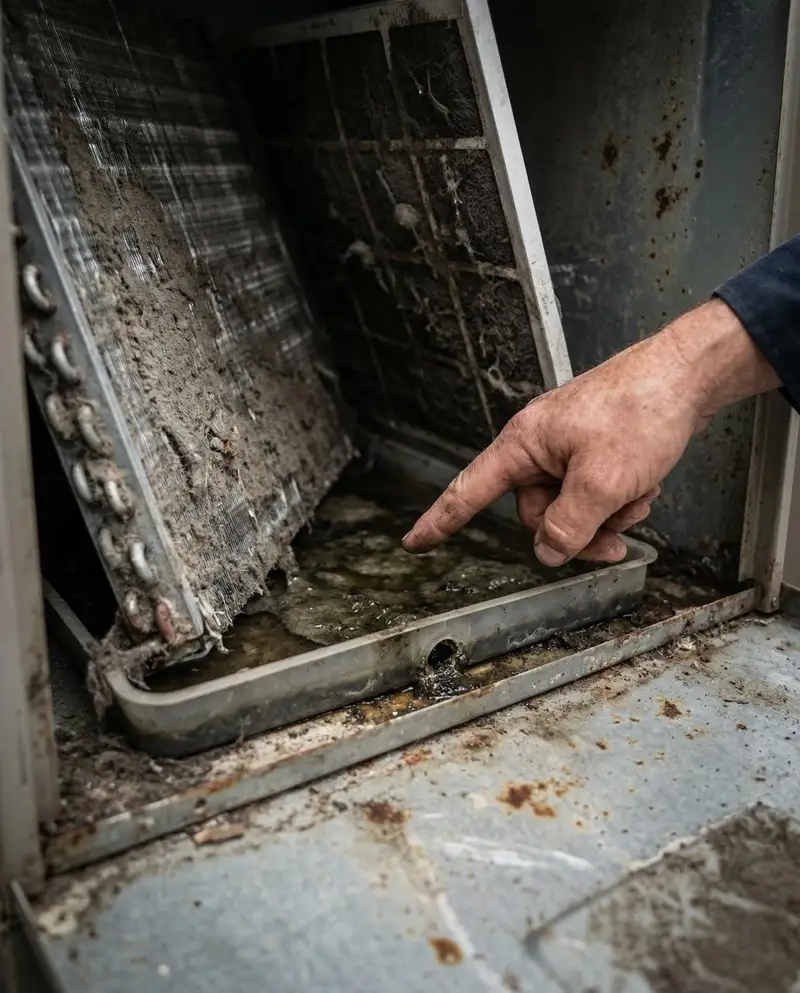
- Condensate drain clogs — Your AC produces gallons of water a day. When the drain line clogs, water stands in the pan and air handler, and growth starts within 24-48 hours. If the system is already dripping, read our AC water leak guide.
- Dirty evaporator coils — The coil is wet whenever the system runs. Dust on a wet coil is a damp, organic surface. Regular AC coil cleaning removes that layer; the guide shows what it costs and includes.
- Oversized AC units — A unit too large for the house cools fast without pulling humidity out, leaving moisture in the ductwork.
This is why we recommend a complete HVAC system cleaning when treating mold. Cleaning the ducts without the coil, drain and air handler leaves the moisture source in place.
What Are the 6 Signs of Mold in Your Air Ducts?
The clearest sign is a musty smell the moment the AC starts, followed by dark spots on the vent covers. These are the six we see most in Miami-Dade and Broward homes (if the smell is rotten at one vent instead of musty at every vent, read how to tell a dead animal or rat smell from mold in the AC first):
- Musty smell when the AC turns on — A damp, earthy odor that arrives when the AC kicks on and fades when it stops means the airflow is passing over growth inside the system.
- Black or green spots around vents — Dark discoloration on or near the supply or return covers means the growth has reached the visible end of the run, and there is more deeper in.
- Symptoms that ease when you leave the house — If a stuffy nose or itchy eyes improve away from home and return indoors, mention it to your doctor and have the ducts looked at; the EPA lists mold among indoor allergen sources. Our guide on why symptoms feel worse at home in Miami covers what to check first.
- A recent renovation, flood or multi-day AC outage — Drywall dust in the runs, storm water in the house, or a sealed home with the compressor off for days are the three histories behind most of the mold jobs we open.
- Dust-like particles blowing from vents — Fine particles pushed out when the AC runs can be growth breaking off inside the duct.
- AC drain line clogging more than twice a year — Repeat clogs usually mean growth inside the line, and the same conditions exist elsewhere in the system.
★ 4.8 Stars — 41 Google Reviews
Licensed #CAC1817115 • BBB A+ Rated • 1,000+ Homes Served
Is Mold in Air Ducts a Health Risk?
It can be, and the people most affected are those already sensitive to mold. The EPA’s Mold and Health page notes that molds produce allergens and irritants, that exposure may cause symptoms such as a stuffy nose, wheezing or itchy eyes, and that people with asthma or mold allergies may react more strongly.
What we can say plainly is what accumulates and what we do about it. Mold, dust and moisture build up on the coil, in the drain pan and along the duct runs; we physically remove it, treat the surfaces and clear the moisture source. Whether that changes anyone’s symptoms is a question for your doctor, not for a duct cleaner. If you are expecting a baby, our note on timing a cleaning before the due date is here.
The EPA’s brief guide to mold, moisture and your home advises not to run an HVAC system you suspect is contaminated, because it can spread mold through the building, and to have the system inspected before it is cleaned. It also does not recommend bleach as a routine mold-cleanup practice. Wiping a vent cover treats the only part you can reach and leaves the coil and trunk line untouched.
If your own AC technician looked at the system and told you it was fine, that does not necessarily contradict what a duct company found — a routine check rarely opens the coil compartment, which is why a second opinion on a duct inspection is worth getting.
Live in a condo and not sure whose equipment it is? Our guide to mold in AC: who to call in Miami covers what usually sits inside your unit, what belongs to the building, and when you need a mold assessor instead of a Miami HVAC contractor.
How Does Professional Air Duct Mold Removal Work?
We inspect with a camera, contain the affected runs, HEPA-vacuum and treat the ducts, then clean the coil and flush the drain so the moisture source is gone. Our FL HVAC licence CAC1817115 covers mould remediation inside HVAC, so the crew that inspects is the crew that does the work. If the growth is on the air handler itself rather than in the runs, that is AC closet mold cleaning — the coil, blower, drain pan and cabinet cleaned and treated where the unit sits.
- Camera inspection — A licensed technician checks the ducts, coil, drain pan, air handler and blower and shows you the footage before a price is written.
- Containment — Affected sections are isolated and negative air pressure is set up so loosened material does not travel to clean rooms while we work.
- HEPA vacuum and antimicrobial treatment — The ducts are cleaned with HEPA-filtered vacuums that capture particles down to 0.3 microns, then an EPA-registered antimicrobial is applied to the cleaned surfaces per the product label.
- Coil and drain cleaning — The evaporator coil is cleaned and the condensate line flushed and treated. Skip these and the growth returns within weeks, because the water never left.
- UV light, if it fits — A UV-C lamp in the air handler is designed by its manufacturer to keep the wet coil surface from growing mold between cleanings. It does nothing for the duct runs, so it is an add-on, not the fix. If the answer is that you do not need a UV light, that is the answer you get.
How Do You Prevent Mold in Air Ducts in Florida?
Keep the system dry: a clear drain line, a filter changed every 30 days and indoor humidity under 60% stop most duct mold before it starts. From Hallandale Beach to Pembroke Pines and Kendall, the drain line is the usual starting point.
- Annual HVAC cleaning — A full HVAC system cleaning removes the dust and organic material mold feeds on. In Miami, once a year, ideally before summer humidity peaks.
- Change the filter every 30 days — A dirty filter restricts airflow, the coil runs colder, and more condensation forms. The 90-day figure on the package is written for drier climates.
- Keep the drain line clear — Standing water in the pan is how most duct mold starts. Maintenance includes a drain flush with an anti-mold treatment. If water is pooling around the air handler, call (305) 607-3244.
- Consider a UV light in the air handler — $199–$1,000 installed. The lamp is designed to keep the coil surface from growing mold between cleanings; it is not a substitute for a clear drain and a clean coil.
- Hold indoor humidity below 60% — A dehumidifier or a correctly sized AC does this; a thermostat with humidity readout shows you where you stand. Aim for 50-55%.
- Duct cleaning every 2-3 years — Even a well-kept system collects debris. Professional duct cleaning every 2-3 years removes it before growth can start.
The bottom line: mold in air ducts is one of Miami’s most common HVAC problems and one of the most preventable. Remediation removes the growth and clears the moisture that fed it; regular cleaning, humidity control and a clear drain keep it from coming back.
One trigger deserves its own mention in storm season: an extended power outage. With the compressor off and the house sealed, growth takes hold far faster than under normal conditions. We break down what a multi-day hurricane outage does to your ductwork and the restart order that keeps loosened material out of your rooms.
Air Duct Mold Removal Cost: Frequently Asked Questions
Who wrote this: the licensed crew that does the work. Air Duct Cleaning Miami holds Florida HVAC contractor licence CAC1817115, is BBB A+ rated, and serves all of Miami-Dade and Broward from Hallandale Beach (33009). Sources cited: EPA Mold and Health, EPA A Brief Guide to Mold, Moisture and Your Home, EPA Should You Have the Air Ducts in Your Home Cleaned?
Book a Mold Inspection Today
Free camera inspection. Licensed #CAC1817115. Same-day appointments available.
Book Mold Inspection →