

AC Coil Cleaning Cost in Miami 2026 — Central Air, Mini-Split, Heat Pump, Condo & Commercial
You set your Pembroke Pines thermostat to 74 degrees but your FPL bill keeps climbing and the air still feels thick. Your system runs all day and barely keeps up. If you have been wondering about AC coil cleaning cost and whether a cleaning could actually fix the problem, here is the direct answer: yes, dirty coils are almost always the cause. The price for professional coil cleaning in Miami depends on your system type and where the equipment is installed. A mini-split starts around $350 to $500. A residential split system in a closet or easy-access location runs $500 to $1,000. An attic unit can run $1,500 or more. Heat pump removal for building cleans goes up to $2,500 to $3,000. In this guide, we break down the exact price by system type, explain what drives the difference, and show you how to get a free estimate before committing to anything.
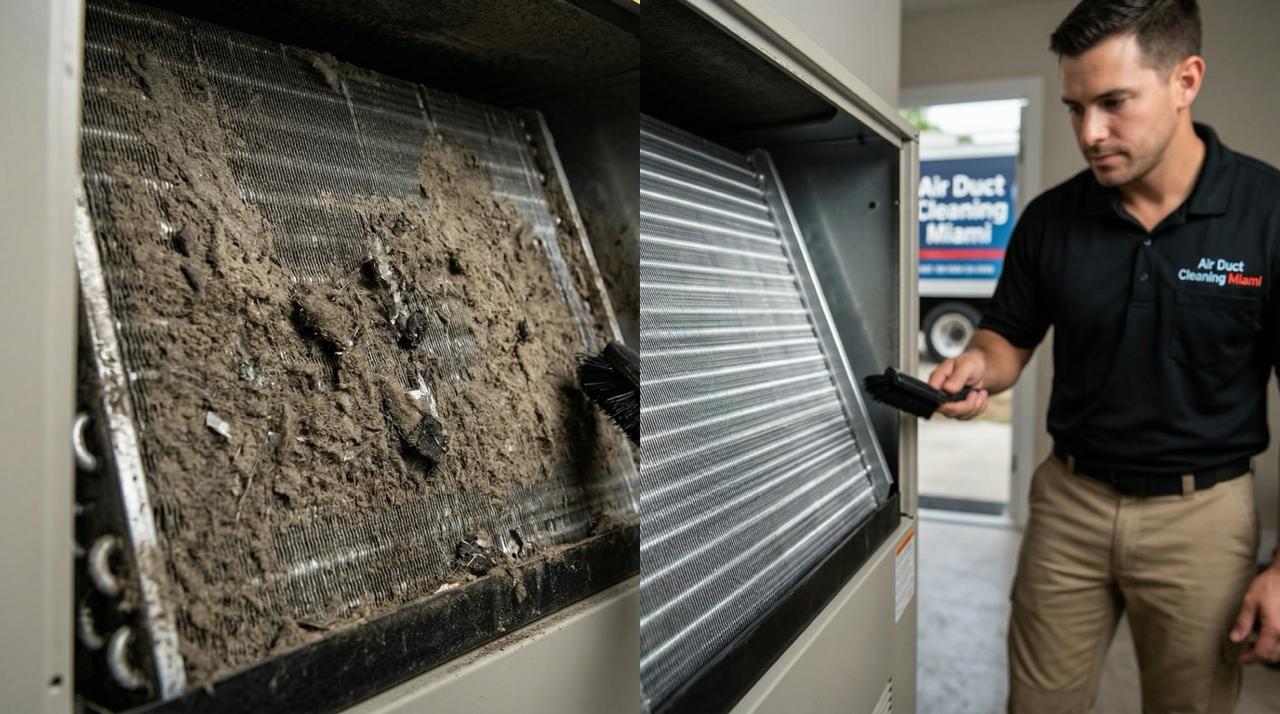
We have cleaned coils in thousands of homes and condos across Miami-Dade and Broward County. We see this pattern every week: a homeowner ignores two or three warning signs until the electric bill forces the issue. By the time we arrive, the evaporator coil (the cold metal part inside your air handler) is caked with a combination of dust, skin cells, pet hair, mold, and the sticky residue that South Florida humidity leaves behind. The condenser coil outside is packed with leaves, pollen, and in coastal buildings from Aventura to Miami Beach, a layer of salt spray corrosion. We clean both coils, measure the improvement in system performance, and the difference is immediate.
In this post, you will find: a complete 2026 price table by system type, the exact warning signs that mean your coils need cleaning now, what our licensed technicians at Air Duct Cleaning Miami do step by step, how condo and heat pump systems differ, and the one question you should ask any contractor before you book.
Free Estimate — AC Coil Cleaning
Get your exact price before we touch anything. Same-day service available across Miami-Dade and Broward. Licensed #CAC1817115 • BBB A+.
2026 AC Coil Cleaning Cost in Miami — Real Prices by System Type
These are the real prices you will see from a licensed FL HVAC contractor in South Florida. Every home is different. Tonnage, access, system condition, and how long since the last cleaning all affect the final number. No contractor can give you an exact price without seeing the unit. What we can give you is a free inspection when you book the job with us.
| System Type / Situation | Price Range | What Drives the Cost |
|---|---|---|
| Mini-split unit (1.5 ton) | $350 – $500 | Smaller tonnage, straightforward access |
| Residential split system — closet / easy access | $500 – $1,000 | Standard tonnage, accessible air handler |
| Residential split system — attic / ceiling | $1,500+ | Difficult access doubles labor time and complexity |
| 3 – 5 ton systems | $750 – $1,500 | Larger coil surface, more cleaning time |
| Heat pump in-place cleaning | Included in system price | Both coils serviced; reversing valve checked |
| Heat pump removal for building clean | $2,500 – $3,000 | Must disconnect ductwork, electrical, plumbing — same scope as a new install |
| Condo / building surcharge | +$1,000 on top of base price | COI insurance required, extra precautions, units spread across floors, South Florida traffic and access complications |
| Chemical coil treatment (add-on) | Included / case-by-case | Contractor-only chemicals, not hardware store products |
| Mold remediation on coils | Additional charge | Requires antimicrobial treatment + containment protocol |
Real-world example: A $750 residential job becomes approximately $1,700 when the unit is in a condo building. That extra cost is real. COI insurance, parking, building access coordination, units often located far from each other, and South Florida traffic all factor in.
Free inspection comes with the job: We inspect the coils as part of every service appointment. You get our findings and the exact price before we start work. Call (305) 607-3244 or book online. No obligation to book, no guesswork.
AC Coil Cleaning Cost Trend — Miami (2021–2026)
Residential split system, standard access — price in USD
Why Every AC Coil Cleaning Quote Is Different
We get asked all the time why two neighbors in the same Pembroke Pines neighborhood get different quotes. The answer is simple: every home is different.
The four factors that move the price most:
- Tonnage. A 1.5-ton mini-split has a much smaller coil to clean than a 5-ton central air system. More surface area means more time and more chemical. That difference alone accounts for hundreds of dollars in price variation. (For full ductless pricing, see our guide to mini-split cleaning cost in South Florida.)
- Access. A unit sitting in a laundry closet is a fundamentally different job than a unit tucked into a tight Kendall attic with one-foot clearance. Attic units can double the labor time. We price the job based on what we actually have to do, not what would be easiest to quote.
- Condition. A system cleaned annually takes 45 minutes to touch up. A system that has not been cleaned in four years, with a coil that looks like grey felt and a drain pan sitting in standing water, takes three times as long and requires chemical treatment. The neglect penalty is real.
- Location (building vs. house). Condo and building jobs carry a surcharge of approximately $1,000 on top of the residential base price. COI insurance, building management coordination, multiple elevators, parking restrictions, units spread across different floors, and South Florida traffic all add labor and liability cost that does not exist on a single-family home job.
Heat Pumps: When Cleaning Becomes a Full Removal Job
Most condos in Aventura, Hallandale Beach, and Sunny Isles Beach run heat pumps, not traditional central air. Most residents do not know this. They know they have air conditioning. They do not know whether it is a heat pump or a standard system.
Here is why it matters for cost: heat pumps can often be cleaned in place with annual maintenance. If you keep up with yearly service, the coils stay clean enough that the technician can do the job without moving anything. That is the best outcome. In-place heat pump cleaning costs the same as a comparable central air system.
But when a heat pump in a building has gone three, four, or five years without service, the contamination is severe enough that cleaning it in place becomes impossible. At that point, the entire unit must come out. We disconnect the ductwork, the electrical connections, and the plumbing lines. The unit comes out of the building. It gets cleaned thoroughly. Then it goes back in. The scope of work is essentially identical to installing a new system. That is why that job costs $2,500 to $3,000.
Annual in-place maintenance prevents the removal scenario entirely. The cost difference between keeping up with service and letting a heat pump go is several thousand dollars.
When Your Electric Bill Is the Warning Sign
Every summer, we take calls from homeowners in Doral, Hialeah, and Coral Springs who say the same thing: "My electric bill jumped $80 last month and I have not changed anything." That is almost always dirty coils.
Here is the physics of it. Your evaporator coil works by absorbing heat from the air passing through it. When a layer of dust and biological growth coats the coil surface, heat transfer drops. Your system has to run longer cycles to pull the same amount of heat out of your home. A 2-millimeter layer of grime can reduce system efficiency by 20 to 40 percent. On a 3-ton Carrier or Rheem system running 10 hours a day in Miami's summer heat, that is $50 to $90 per month in wasted electricity.
The condenser coil outside works in reverse: it releases heat from the refrigerant into the outdoor air. When it is packed with debris, that heat cannot escape efficiently. Your compressor overheats. It short-cycles. It eventually fails. A new compressor on a Goodman or Trane central air system costs $1,800 to $3,500 installed. A coil cleaning costs $500 to $1,000. That math is not complicated.
The 5 Warning Signs That Mean Your Coils Need Cleaning Now
- Your electric bill is $50 to $100 higher than the same month last year with no change in habits or occupancy. South Florida FPL bills spike in June through September, but a sudden jump outside the seasonal pattern is a coil problem until proven otherwise.
- Air from your vents feels weak or less cold. When I push my hand against the vent and the air barely moves, that is often a frozen evaporator coil. Restricted airflow causes condensation to freeze on the coil surface, which then blocks even more air. It compounds fast.
- Your AC runs constantly but never reaches your setpoint. A system that runs all day and never gets below 78 in a Fort Lauderdale home set to 72 is working at a serious efficiency deficit. Dirty coils are the leading cause.
- You smell something musty or mildewy every time the AC turns on. That is biological growth on the evaporator coil or in the drain pan. The same moisture that makes Miami miserable in August creates a perfect mold environment inside your air handler. That growth is what your family is breathing when the system runs.
- You can see buildup on the outdoor condenser fins. If you look at the metal fins on your outdoor unit and they look grey, clogged, or bent, the coil behind those fins is dirty. You can see this without tools. If you cannot see light through the fins at all, the coil needs professional cleaning.
What Dirty Coils Do to Your Indoor Air
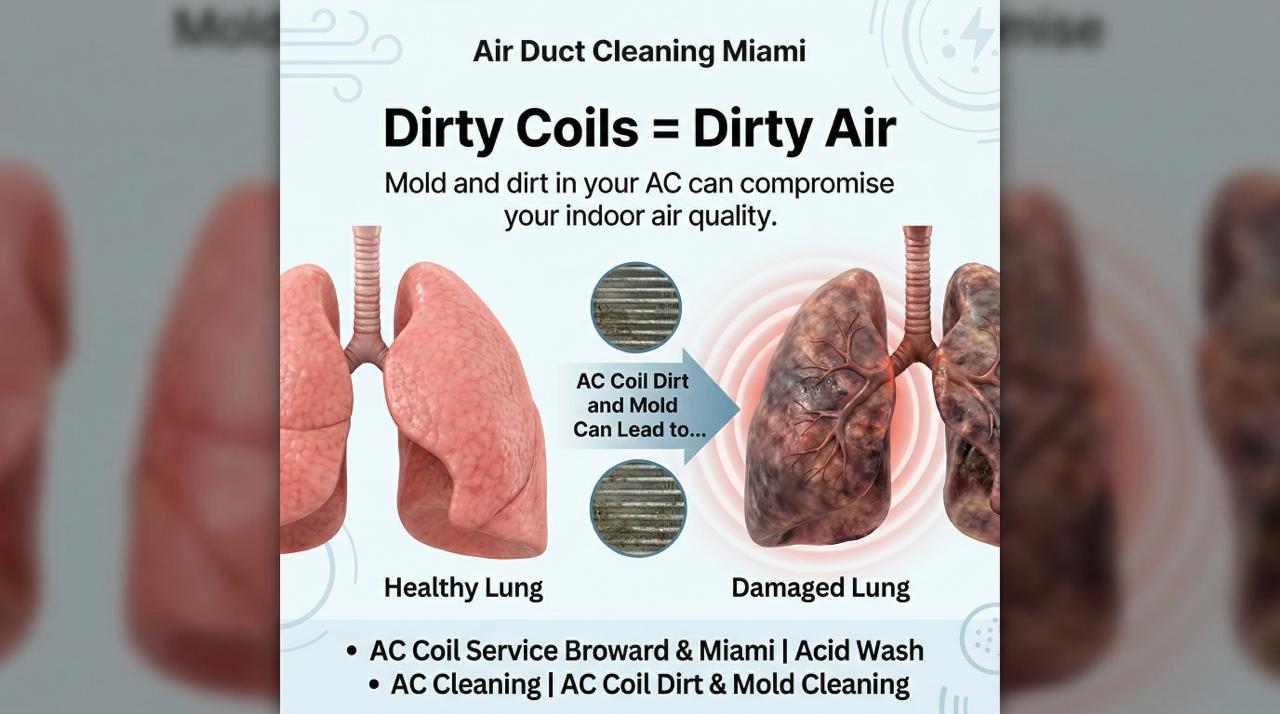
- 1Mold spores circulate on every cooling cycle. Mold colonies growing on a dirty evaporator coil release spores into your airflow every time the blower runs. In Miami's humidity, growth accelerates year-round — not just in wet season.
- 2Allergens concentrate as the coil traps particles. Dust, pet dander, pollen, and skin cells that the coil captures instead of releasing get recirculated through your home as the buildup breaks loose over time.
- 3Respiratory irritation worsens for sensitive household members. Children, elderly residents, and anyone with asthma or allergies are the first to notice when coil contamination degrades air quality. Chronic symptoms indoors that clear up outdoors are a strong signal.
- 4Volatile organic compounds (VOCs) amplify when mold is present. Microbial growth on coils produces VOCs as byproducts of biological activity. These compounds contribute to headaches, fatigue, and the persistent musty odor many Miami homeowners describe as "the AC smell."
Central Air vs. Mini-Split vs. Heat Pump: What Changes the Price
Not all coil cleanings are the same job. The system type determines how much access is needed, what tools are required, and how long it takes. This is why the price range for HVAC coil cleaning varies across system types.
Central Air Systems (the most common in Miami homes)
Central air systems in homes throughout Miami-Dade, Kendall, and Miramar typically have a split system: an indoor air handler in a closet or attic with the evaporator coil, and an outdoor condenser unit in the yard or on a patio slab. Brands we service daily include Rheem, Carrier, Bryant, Goodman, Payne, and Ruud.
Cleaning the evaporator coil on a central air system requires: shutting the system down, accessing the air handler cabinet, removing or partially disassembling the coil access panel, applying coil cleaner, allowing dwell time, and flushing. If the coil is in an attic, access is harder and the job takes longer. Attic units in older Homestead and Kendall homes sometimes have corroded drain pans that need replacement at the same time.
The outdoor condenser coil cleaning involves: shutting power off at the disconnect, removing the condenser fan blade and top grille, rinsing fins with low-pressure water (never a pressure washer, which destroys fins), applying coil cleaner from the inside out, and reinstalling. We straighten bent fins with a fin comb as part of the service.
Mini-Split Systems (most condos in Hallandale Beach, Aventura, and Sunny Isles)
Mini-split systems, also called ductless mini-splits, are the dominant system type in Broward County condos. Hallandale Beach towers, Aventura high-rises, Sunny Isles buildings, and most new construction condos from Hollywood to Miami Beach run mini-splits rather than central air.
Cleaning a mini-split indoor head is a more involved process than most people expect. It requires: removing the front panel and filter, using a specialized coil cleaning bag to catch drainage, applying foaming coil cleaner to the evaporator coil and blower wheel (the spinning drum that moves air), rinsing thoroughly, cleaning the drain line, and reassembly. The blower wheel is the part most cleaners skip. When it is caked with grey slime, your air quality problem is not going away no matter how clean the coil looks.
Multi-zone mini-split systems with 2 to 4 indoor heads cost more per visit but less per head than single-zone visits, because the outdoor compressor unit cleaning is shared across the invoice.
Heat Pumps (how most South Florida condos heat AND cool)
Most people in Aventura, Doral, and Hallandale Beach think their system is a regular AC. It is not. It is a heat pump. Heat pumps work in both directions: cooling in summer by absorbing indoor heat and releasing it outside, heating in winter by reversing the process and pulling heat energy from the outdoor air into the home.
Because both the indoor and outdoor coils alternate between evaporator and condenser duty, both accumulate buildup at roughly equal rates. You cannot clean only the indoor coil and call the job done. Heat pump coil cleaning requires full service on both coils, plus a check of the reversing valve and defrost controls to make sure nothing is damaged.
In barrier island buildings, we regularly see salt-air corrosion on outdoor coil fins that accelerates buildup 30 to 40 percent faster than inland systems in Doral or Hialeah. If your building is within a mile of the ocean, your outdoor coil needs attention more often than the standard 12 to 18-month cycle.
★ 4.8 Stars — We Specialize in Coil Cleaning
Licensed FL HVAC Contractor #CAC1817115 • BBB A+ Rated • 1,000+ Homes Served • Serving all Miami-Dade & Broward ZIP codes
What a Professional Coil Cleaning Actually Includes
Not every company that advertises coil cleaning actually does the job. Some contractors spray a quick rinse on the outdoor fins, collect a check, and leave. That is not a coil cleaning. Here is what a thorough service from a licensed FL HVAC contractor includes:
- Full system shutdown and safety checks. We pull the disconnect at the outdoor unit, verify the system is fully off at the air handler, and check electrical connections for signs of damage before touching anything.
- Evaporator coil access. On most air handlers, this means removing the access panel and sometimes the drain pan. On older systems in Hollywood and Pembroke Pines, we often find drain pans that are rusted through and holding standing water. We photograph everything so you can see the condition before and after.
- Coil cleaner application. We use a no-rinse alkaline foam or acid-based cleaner depending on coil type and contamination level. The cleaner dwell time is critical. Rinsing too early means the contaminants are not fully broken down. We wait the full manufacturer-specified time.
- Drain line flush. While the coil cleaner dwells, we flush the condensate drain line with a wet-dry vac or nitrogen. A clogged drain line is how a coil cleaning becomes a water damage claim. AC water leaks in Miami cause thousands of dollars in ceiling and drywall damage when drain lines back up.
- Condenser coil cleaning. We remove the top panel, drop the fan blade, and rinse the coil from inside out. Rinsing from outside pushes debris deeper into the coil. Inside-out flushing pushes it out the way it came in.
- Fin straightening. Bent fins block airflow. We use a fin comb to straighten damaged fins on the condenser coil as part of standard service.
- Post-cleaning performance check. We measure the temperature differential between the supply and return air (the drop should be 18 to 22 degrees Fahrenheit), check refrigerant pressures, and confirm the system is operating within spec before we leave.
When a job is done correctly, you feel it immediately. The air is colder, the system cycles off instead of running all day, and within one billing cycle your FPL bill reflects the difference.
Why This Is Not a DIY Job — And Why Unlicensed Workers Are Dangerous
We get asked about DIY coil cleaning regularly. Hardware stores sell spray-on coil cleaners. YouTube has tutorials. But here is what those tutorials do not tell you:
- The wrong cleaner destroys aluminum fins. Acid-based cleaners react with aluminum. Applied incorrectly, they corrode the coil itself. We have inspected systems where a homeowner used the wrong product and turned a $300 cleaning into a $1,500 coil replacement.
- Evaporator coils are under pressure. The refrigerant inside runs at high pressure. Damaging a coil connection means a refrigerant leak that requires EPA 608 certification to repair. No hardware store product fixes that.
- You cannot access the blower wheel without disassembly. The blower wheel (the fan drum that moves air through your home) sits behind the coil inside a sealed housing. Cleaning the coil and leaving the blower wheel covered in slime solves half the air quality problem at best.
- Electrical components are exposed. Air handler cabinets contain high-voltage wiring, capacitors, and contactors. A licensed contractor knows exactly what not to touch. A homeowner with a spray bottle does not.
The same reasoning applies to the full AC tune-up process: education and awareness belong to you, the actual work belongs to a licensed pro. Florida HVAC licensing exists for a reason. It is not paperwork, it is proof that the person in your home knows how to work safely on pressurized refrigerant systems.
⚠ DANGER: Handymen and Unlicensed Workers Do Not Belong Near AC Coils
This is not a warning we add lightly. We have seen the results of unlicensed coil cleaning, and they are serious.
Here is what an unlicensed handyman or uncertified worker typically does wrong:
- They push dirt deeper into the coil. Using the wrong technique or the wrong equipment, an untrained worker can compress the debris that is sitting on the coil surface, packing it further into the fins. A coil that was borderline gets worse, not better.
- They use the wrong chemicals. Coil cleaning chemicals are contractor-only products. They are not sold at Home Depot. When an unlicensed worker reaches for what is available at the hardware store, the wrong chemical can react with the aluminum fins and corrode the coil. That is a coil replacement, not a cleaning.
- They can cause a refrigerant leak. Freon (the refrigerant inside your coils) runs under high pressure. Damaging a coil connection during cleaning releases refrigerant into your home. This is not a minor inconvenience. Freon displaces oxygen in an enclosed space. At high enough concentration in a room or closet where your air handler sits, it is a suffocation risk. People have died from refrigerant exposure in confined spaces. This is a documented safety hazard, not an exaggeration.
- They have no license to fix what they break. EPA Section 608 certification is required by federal law to handle refrigerants. A licensed FL HVAC contractor holds this certification. An unlicensed handyman does not. If something goes wrong during their work, they cannot legally repair it, and your homeowner's insurance will not cover damage caused by unlicensed work.
Before you hire anyone to touch your AC coils, do one thing: verify their Florida state license.
You can check any contractor at the Florida Department of Business and Professional Regulation website. Our license is CAC1817115. If the person you are about to hire cannot give you a Florida HVAC or mechanical contractor license number, do not let them touch your system. It is not worth the risk.
Most licensed HVAC companies offer free estimates. There is no reason to gamble on an unlicensed worker to save money on a service that involves pressurized refrigerant, live electrical components, and contractor-only chemicals.
Commercial Coil Cleaning: Restaurants, Offices, and Multi-Unit Buildings
Commercial coil cleaning in South Florida is a different operation than residential service. Rooftop units (RTUs) on restaurants in Wynwood, office buildings in Brickell, and retail spaces in Coral Springs use larger air handlers and condenser coils that require commercial-grade cleaning equipment.
Cost factors for commercial systems include: unit tonnage (larger units take longer), roof access requirements, number of units on one service call, contamination level (restaurant kitchens coat evaporator coils with grease and organic debris faster than any other environment), and whether a maintenance agreement is in place.
For commercial coil cleaning quotes in Miami-Dade or Broward, call (305) 607-3244 directly. We schedule commercial work during off-hours to avoid disrupting business operations.
What Happens After Coil Cleaning: Keep It Clean Longer
A clean coil stays clean longer when you protect it. After a professional cleaning, three things make a meaningful difference:
- Filter maintenance. A MERV 8 to 11 filter (the Minimum Efficiency Reporting Value measures how well a filter captures particles) changed every 60 to 90 days catches the dust before it reaches the evaporator coil. In Miami with high pollen counts and salt air, change it on the shorter end. Choosing the right AC air filter for your Miami home is the cheapest maintenance step you can take.
- UV air purification technology. Ultraviolet light systems mounted in the air handler prevent biological growth from reestablishing on the coil surface. We install these as part of our complete HVAC cleaning service when conditions warrant. We never name specific brands because the technology matters more than the label.
- Annual maintenance visits. South Florida systems run hard. An annual AC maintenance check that includes a coil inspection and light cleaning prevents the heavy buildup that requires a full chemical service every time. Systems with annual maintenance consistently outlast systems without it by 3 to 5 years.
We see the difference on every job. The systems that get annual attention look dramatically different inside than the systems that go 3 or 4 years between service calls. The coils that get regular maintenance clean up in 45 minutes. The neglected ones take 2 hours and sometimes need chemical treatment or coil replacement.
What Miami Homeowners Say After Coil Cleaning
"My Carrier unit in Doral was running all day and my FPL bill was $220 more than last summer. The technician showed me the evaporator coil on his phone camera before he cleaned it. I could not believe what was growing in there. After the cleaning, the system hits temperature in 25 minutes and my bill is back to normal."
"My Hallandale Beach condo mini-split smelled musty every time it kicked on. I had another company clean it and the smell came back in two months. This company cleaned the blower wheel properly, not just the filter. The smell has not come back in six months."
"I manage a 4-unit Aventura building and they serviced all four systems in one day. Gave me one invoice, explained what each unit needed, and the price was exactly what they quoted on the phone. This is the only HVAC company I call for the building now."
AC Coil Cleaning FAQ
AC coil cleaning in Miami costs $500 to $1,500 for most residential systems in 2026. Mini-splits (1.5 ton) run $350 to $500. Residential split systems in closets cost $500 to $1,000. Attic units run $1,500 or more. Condo and building jobs add approximately $1,000 due to COI insurance. Commercial systems range from $2,000 to $4,000. Sanitization and deodorization is about $300. Call (305) 607-3244 for a free estimate before any work begins.
The five signs: (1) electric bill is $50 to $100 higher than the same month last year, (2) air from vents feels weak or less cold, (3) AC runs all day and never hits your setpoint, (4) musty smell when the system runs, (5) visible buildup on the outdoor condenser fins. In Miami, where systems run 10 to 12 months per year, coils typically need cleaning every 12 to 18 months. Coastal properties near the ocean need it more frequently due to salt-air corrosion.
Yes. We offer a free estimate with every coil cleaning inquiry. A licensed technician (FL HVAC License #CAC1817115) inspects both your evaporator and condenser coils, gives you an exact price, and explains what is needed. No obligation to book. Same-day service is available for most Miami-Dade and Broward locations. Call (305) 607-3244 or book online.
Mini-split coil cleaning costs $350 to $500 per unit in Miami for 1.5 ton systems. The full indoor head service includes the evaporator coil, blower wheel, drain line, and filter housing. Multi-zone systems with 2 to 4 heads cost more per visit but less per head than single-unit cleanings. Condo building jobs carry additional surcharges for COI insurance and access. Most Hallandale Beach, Aventura, and Sunny Isles condo units are mini-split systems.
Heat pump coil cleaning costs $750 to $1,500 for residential service and $2,500 to $3,000 when the unit must be fully removed in a building. Both coils alternate roles between cooling and heating. When a heat pump goes years without service, the entire unit must come out — disconnecting ductwork, electrical, and plumbing. Annual in-place cleaning prevents this expensive removal. Coastal properties see buildup accelerate 30 to 40 percent faster.
Yes. A dirty evaporator coil forces your system to run longer cycles, burning more electricity to achieve the same cooling. After a professional cleaning, most Miami homeowners see FPL bills drop $40 to $90 per month during peak summer months. The cleaning typically pays for itself within one or two billing cycles. We regularly see efficiency improvements of 20 to 40 percent after cleaning severely neglected coils.
The evaporator coil is the indoor coil inside your air handler. It absorbs heat from your home and gets coated with dust, mold, and biological growth because condensation constantly passes through it. The condenser coil is the outdoor coil inside your compressor unit. It releases heat outside and collects leaves, pollen, grass clippings, and coastal salt spray. Both need separate tools and cleaning methods. Cleaning only one is a half-job that leaves half your problem in place.
A standard residential coil cleaning (both evaporator and condenser) takes 1.5 to 2.5 hours. Mini-split head cleanings take 45 to 90 minutes per indoor unit. If chemical treatment or mold remediation is needed, add 30 to 60 minutes for dwell time and rinse. We schedule same-day service throughout Miami-Dade and Broward County when you call before noon at (305) 607-3244.
Read Next
- Mini split cleaning service in Miami — who does it, what's included, and how often
- 7 Signs Your AC Coil Needs Cleaning — Miami Homeowner Guide
- Why AC Maintenance Costs Less Than You Think in 2026 (and What Skipping It Actually Costs)
- AC Tune-Up Cost in Miami: What You Pay and What You Get
- AC Not Cooling? 10 Real Reasons — Diagnosed by a Licensed Miami Tech
- Air Duct Cleaning Cost in Miami: The Complete 2026 Price Guide
Ready to Book Your Coil Cleaning?
Free estimate, same-day availability, no-obligation price before we start. Licensed #CAC1817115 • BBB A+ • 1,000+ Miami-Dade & Broward homes served.
Get Free Estimate →