

7 Signs Your AC Coil Needs Cleaning (Miami Homeowner Guide 2026)
Your FPL bill jumped $80 last month and your AC never seems to reach the temperature you set. You have replaced the filter. Nothing changed. Here is what most Miami homeowners miss: a dirty AC coil quietly steals 20 to 40 percent of your system’s cooling power and drives electricity costs up every month until it is fixed. In this guide we walk you through the 7 warning signs South Florida homeowners should never ignore, what each sign means for your system, and when to call a licensed HVAC technician for professional AC coil cleaning before a dirty coil turns into a much bigger repair bill. Not sure why this matters so much? Read our full breakdown on why regular AC cleaning matters in Miami.
Free Coil Inspection — No Obligation to Book
A licensed HVAC technician inspects both your evaporator and condenser coils, gives you an exact price, and explains everything clearly before any work begins. Same-day available.
What Your AC Coil Actually Does
Your AC system has two coils. The evaporator coil (the cold, indoor coil inside your air handler) absorbs heat from your home’s air. The condenser coil (the outdoor coil inside your compressor unit) releases that heat outside. Together they are the heat transfer engine that makes your home comfortable in South Florida’s brutal summer heat.
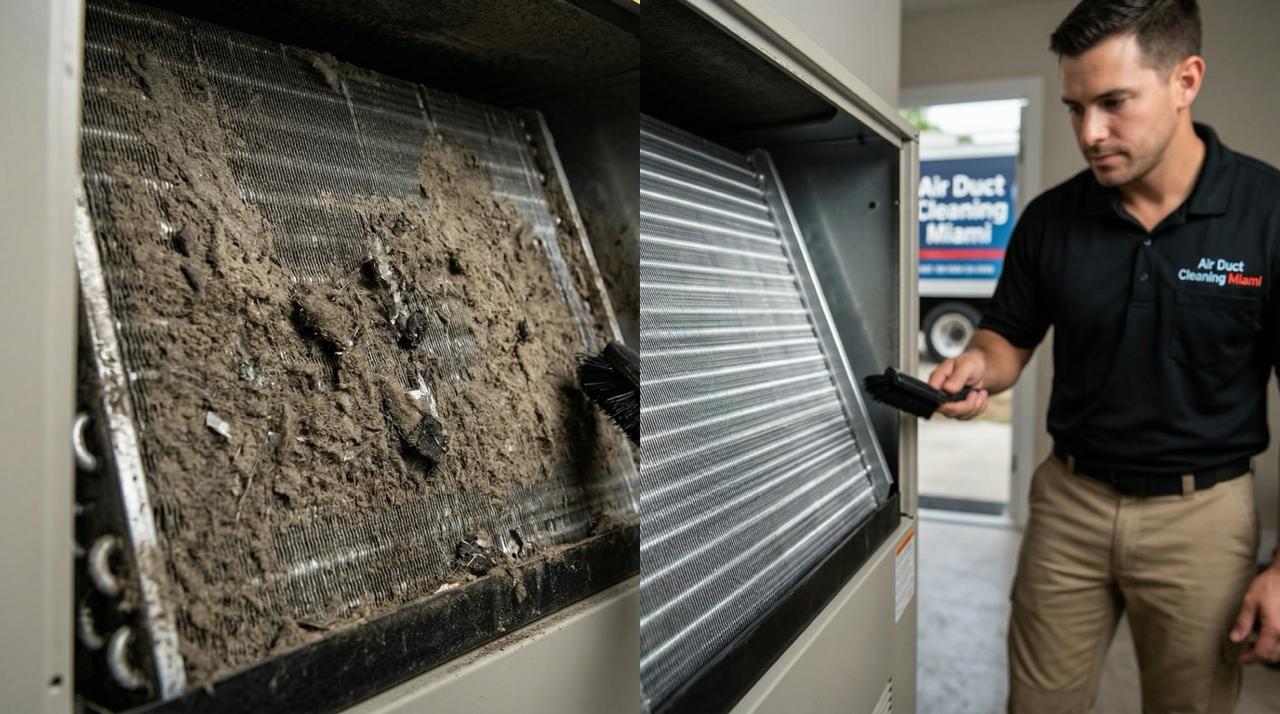
Think of your evaporator coil like a cold soda can on a humid day. Condensation forms on it constantly. Every cubic foot of air that passes through your system deposits dust, pet dander, skin cells, and biological particles onto that wet coil surface. Over time that coating acts like a blanket, blocking the heat transfer that cools your home.
The condenser coil outside faces a different enemy: pollen, grass clippings, leaves, and in coastal Miami-Dade and Broward County neighborhoods like Aventura, Hallandale Beach, and Miami Beach, salt spray that corrodes the fins and accelerates buildup.
When either coil gets dirty enough, your whole system suffers. Here are the 7 signs to watch for. If you want a broader whole-system self-check that covers ducts, blower, and drain line too, see our guide on how to know if your AC needs cleaning in Miami.
Your FPL Bill Is Higher Than Usual With No Obvious Reason
A dirty evaporator coil forces your compressor to run longer to cool the same space. The math is simple: if your AC used to run 6 hours a day to keep your Doral home at 74 degrees, a fouled coil might push that to 9 or 10 hours. Same thermostat setting. Much higher electric bill.
Most Miami homeowners with dirty coils see FPL bills run $50 to $100 higher per month during peak summer. If your bill jumped this spring and you have not changed your habits, a dirty coil is high on the suspect list.
Weak Airflow From Your Vents Even Though the System Runs
Put your hand over a supply vent when your AC is running. Does the air feel strong or weak? A severely fouled evaporator coil restricts airflow the same way a clogged drain restricts water. The air cannot move through the restricted coil surface efficiently, so less of it reaches your vents.
This is different from dirty air ducts, which also cause weak airflow. The diagnostic difference: dirty ducts cause weak flow from specific vents. A dirty coil causes weak airflow from all vents at once. If every room in your Pembroke Pines home has weak flow simultaneously, the coil is the likely culprit.
The AC Runs Constantly But Your Home Never Reaches the Set Temperature
You set the thermostat to 73. It is 78 in the living room and the AC has been running for two hours. Sound familiar? When coils are dirty, your system loses the ability to transfer enough heat per cooling cycle. It just keeps running, burning electricity, and never quite getting there.
We see this constantly in older Coral Gables and Hialeah homes with 2005 to 2012 Carrier, Rheem, or Goodman units that have never had their coils professionally cleaned. The system is not broken. It is just coated. A thorough coil cleaning restores the heat transfer surface and usually resolves the temperature problem without any parts replacement.
A Musty or Mildewy Smell When the AC Kicks On
“I feel worse indoors than outdoors” is one of the most common things we hear when we first arrive at a job. That musty smell coming from your vents when the AC starts is often a dirty evaporator coil problem, not a duct problem.
Your evaporator coil is constantly wet with condensation. When dust and organic particles coat that wet surface, they become a food source for mold, bacteria, and mildew. Every time the system runs, it circulates those particles through your home’s air. In Miami’s humidity, this happens faster than in drier climates.
If you have already checked your air filter and ruled out mold in your ducts, the coil is the next logical suspect. The musty smell is the biological growth burning off into your living space every time the fan runs.
Ice Forming on the Indoor Unit or Refrigerant Lines
If you have ever opened your AC closet and seen frost or ice on the copper refrigerant lines coming out of your air handler, you are looking at a coil problem in progress. Here is what happens: when a dirty evaporator coil restricts airflow, the refrigerant inside it cannot absorb enough heat. The coil drops below the freezing point of the condensation on its surface. Ice forms. The ice makes the airflow problem worse. Eventually the system shuts down on a safety switch — often at the worst possible time, a Sunday afternoon in July when it is 94 degrees outside.
We do service calls in Miramar, Sunrise, and Hollywood for this exact scenario regularly during peak summer. The homeowner wakes up to a warm house and discovers ice inside the AC cabinet. The fix is usually a full coil cleaning plus a refrigerant check once the ice thaws.
Visible Dirt or Grime on Your Outdoor Unit Fins
Walk to your outdoor condenser unit. Look at the metal fins — the thin, closely spaced aluminum slats that surround the unit. If they look dark, clogged, or matted down with debris, your condenser coil is restricted.
The outdoor coil is your system’s heat dump. It has to release all the heat pulled out of your home into the outdoor air. When the fins are blocked by dirt, grass, leaves, or salt residue, that heat cannot escape efficiently. Your system runs hotter, works harder, and wears faster.
Coastal properties in Fort Lauderdale Beach, Surfside, and Bal Harbour see this faster than inland neighborhoods because salt in the sea breeze accelerates corrosion and causes particles to stick to the fins. If your outdoor unit is within a quarter mile of the ocean, plan on annual condenser coil service rather than every 18 months.
Your AC Is More Than 2 Years Old and Has Never Had a Coil Cleaning
This one is not a symptom. It is a math problem. In Miami and South Florida, an AC system runs 10 to 12 months per year. That is nearly double the operating hours of a system in a northern state where AC is seasonal. By the time a South Florida AC reaches its second year without a coil cleaning, it has already accumulated the equivalent of three or four years of buildup compared to a system in Chicago or Denver.
We have cleaned over 1,000 homes across Miami-Dade and Broward County. The most dramatic before-and-after cases are always the systems that have never been touched. Carrier, Trane, Bryant, Rheem, Goodman, and Lennox units all respond the same way: after a proper coil cleaning, airflow improves immediately and the system cycles shorter and more efficiently.
How Bad Is Your Coil? A Quick Self-Check
Use this table to estimate how urgently your coil needs attention before calling us for the full diagnostic.
| What You Notice | Urgency | Likely Cause |
|---|---|---|
| FPL bill $50+ higher than same month last year | High | Dirty evaporator coil reducing efficiency |
| Weak airflow from all vents | High | Fouled evaporator coil blocking airflow |
| AC runs but never reaches set temp | High | Coil heat-transfer capacity degraded |
| Musty smell from vents | High | Mold/bacteria on wet evaporator coil surface |
| Ice on copper lines or indoor unit | Urgent | Restricted airflow from severely fouled coil |
| Visible debris on outdoor unit fins | Medium | Dirty condenser coil reducing heat rejection |
| System 2+ years old, never cleaned | Preventive | Proactive service before symptoms appear |
What Happens if You Don’t Clean the Coil
Dirty coils do not just cost more to run. They cause cascading damage. When your evaporator coil is severely restricted, the reduced airflow causes refrigerant pressure inside the coil to drop. Low refrigerant pressure causes the compressor to work outside its designed operating range. Compressor failures in Miami average $1,500 to $3,500 to repair or replace, depending on system size and age.
Real case from our records, 2026: A homeowner in a Hallandale Beach high-rise went two years without coil service on her heat pump system. The evaporator coil was completely bridged with organic growth. By the time she called us, the compressor had already failed from running overloaded for months. The coil cleaning would have cost under $1,500. The compressor replacement and coil cleaning together exceeded $4,200. The coil cleaning would have prevented the entire failure.
The second risk is mold spread. A dirty wet coil that grows biological colonies circulates those particles through your entire home, including the ductwork. What starts as a coil problem can colonize duct surfaces, insulation, and air handler components. That is a much more expensive remediation.
Can You Clean the Coil Yourself?
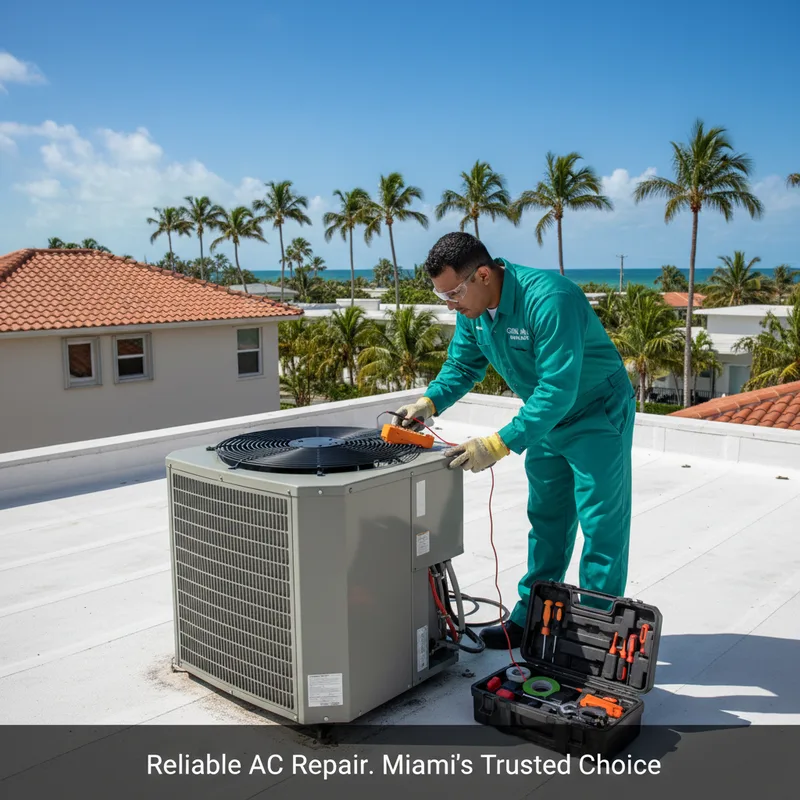
The condenser coil outside can be rinsed gently with a garden hose on low pressure, spraying from inside out (through the fins, not against them) to push debris outward. That removes surface debris and is fine as a monthly maintenance habit during heavy-pollen spring months.
The evaporator coil is different. Do not attempt to DIY clean your evaporator coil unless you are an experienced HVAC technician. Here is why:
- The coil sits inside a sealed air handler cabinet, often in a tight closet or attic with limited access
- Professional coil cleaners are caustic. The wrong concentration or application technique bends aluminum fins and destroys the coil
- The rinse process must be controlled. Cleaner runoff that floods the drain pan incorrectly causes water damage inside the air handler
- Many equipment warranties are voided by DIY coil cleaning attempts
- Licensed FL HVAC contractors (CAC1817115) carry liability insurance for any accidental damage. A DIY attempt leaves you fully exposed
The right move is a free diagnostic estimate from a licensed contractor. You find out exactly what the coil looks like, get the exact price, and then decide.

We Service All Major Brands in Miami-Dade & Broward
Carrier, Trane, Rheem, Goodman, Bryant, Lennox, Daikin, York, Ruud — if it cools your home, we clean it. Same-day service available when you call before noon.
How Often Should Miami Homeowners Clean AC Coils
Our general guideline for South Florida:
- Standard residential systems (central air, split system): every 12 to 18 months
- Mini-split systems (ductless): every 12 months, more often in humid spaces like garages or laundry rooms
- Heat pumps in condos (Aventura, Hallandale Beach, Doral high-rises): every 12 months. Heat pumps run year-round for both cooling and heating, so they accumulate buildup faster
- Coastal properties within a half-mile of the ocean: annual condenser coil service minimum
- Homes with pets: add 3 to 6 months to any schedule. Pet dander is one of the fastest coil-fouling materials
If you are unsure when your system was last cleaned, check the service sticker on your air handler (usually inside the cabinet door). No sticker means it probably has not been done since installation. At that point, the coil cleaning is overdue regardless of the year.
What to Expect During a Professional Coil Cleaning
When our licensed HVAC technician arrives, here is what the full service covers:
- Diagnostic inspection: both coils are inspected with a flashlight and coil mirror. Buildup level, fin condition, and drain pan condition are assessed.
- Indoor evaporator coil cleaning: access panel removed, professional foaming coil cleaner applied, dwell time allowed, then rinsed through the drain pan. HEPA-grade dry vacuum used for thick buildup before chemical application.
- Drain pan inspection and cleaning: the condensate drain pan is checked for standing water, mold, and proper drainage. Drain line is flushed.
- Outdoor condenser coil cleaning: fins straightened if bent, professional coil cleaner applied, unit rinsed from inside out.
- Antimicrobial treatment (when mold or odor present): EPA-registered antimicrobial fogger applied to coil surfaces and air handler interior.
- System test run: system is restarted and airflow, supply temperature drop, and operating pressures are checked to confirm the cleaning improved performance.
Related Coil and AC Maintenance Topics
If you are noticing coil-related symptoms, these related posts cover the adjacent problems Miami homeowners typically run into:
- Who cleans mini split ACs in Miami — what the service includes and how often to schedule it
- AC coil cleaning cost in Miami — what central air, mini-splits, and condos actually pay
- Why is my AC leaking water? (often tied to a dirty coil clogging the drain)
- AC running but not cooling Miami — full diagnostic guide
- Mold in air ducts — when a dirty coil spreads to the ductwork
- What does AC maintenance include in Miami — full 31-point checklist
For the full service overview, visit Air Duct Cleaning Miami to see our complete range of licensed HVAC services across Miami-Dade and Broward County.
