

Homeowner Warning: Why AC Work in Florida Must Be Done by a Licensed Contractor
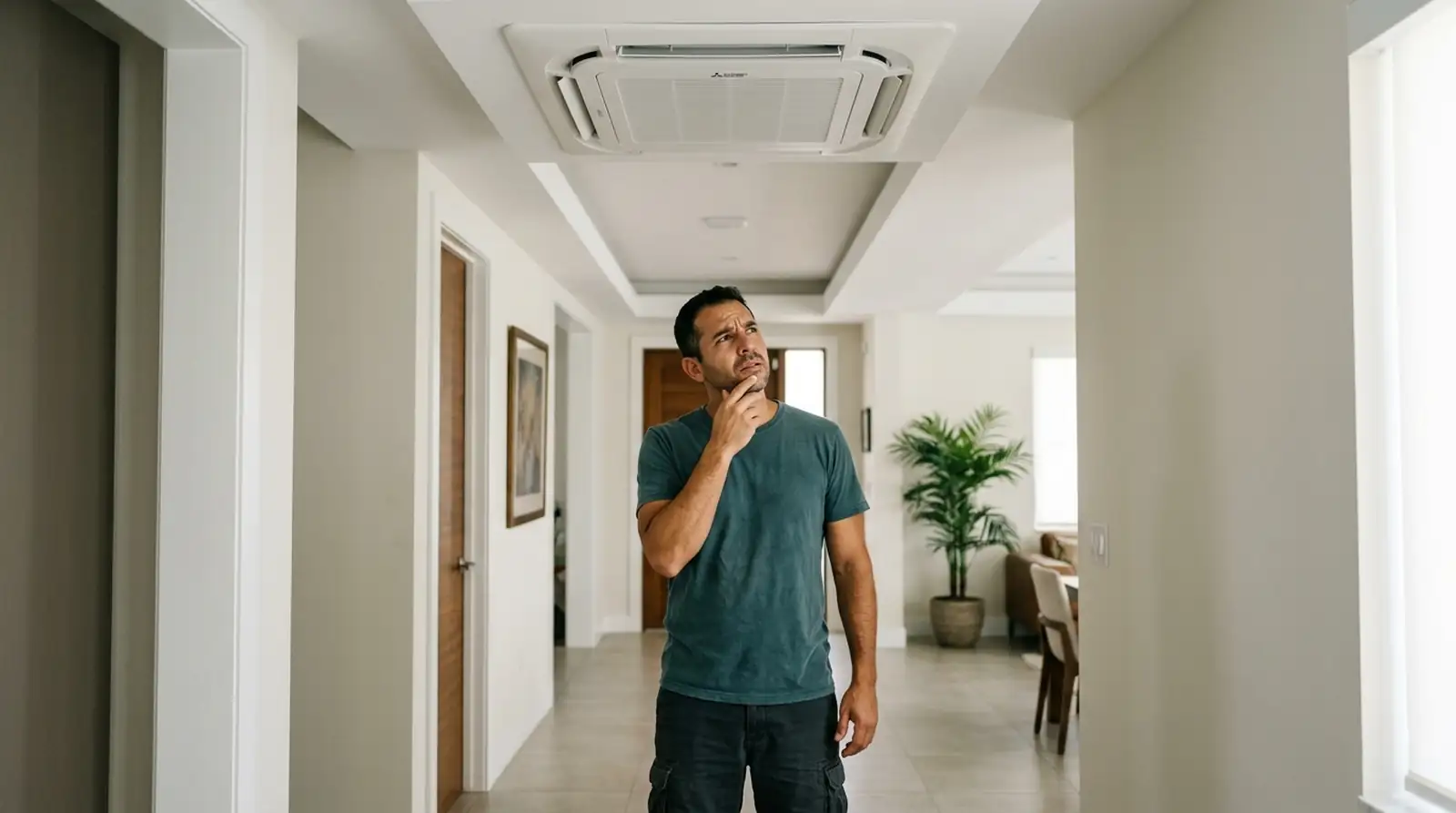
Florida law requires a licensed HVAC contractor for all AC work — and the reason matters more than the law. Your air conditioner runs four skilled trades at once: high-voltage electrical, pressurized refrigerant chemistry, condensate plumbing, and mechanical components under load. Improper work on any one can cause fire, flooding, or a refrigerant hazard inside your home. Under Florida Statute 489.127, unlicensed AC work for compensation is a crime — but your bigger risk as a homeowner is voided insurance, a dead warranty, and no recourse. Air Duct Cleaning Miami is a licensed Florida HVAC contractor (#CAC1817115) serving Miami-Dade and Broward.
Your neighbor’s brother-in-law does AC on the side. Someone on Facebook Marketplace offers a full tune-up for $40 cash. A guy in an unmarked van leaves a flyer on your door in Miramar every summer before hurricane season. You might wonder: is it illegal to do AC work without a license in Florida, or is this one of those rules nobody enforces?
Yes — it is illegal. Under Florida Statute 489.127, any HVAC work done for compensation without a valid state contractor license is a criminal offense. But here is the part most homeowners miss: the law exists not because the state wants to protect contractors’ turf, but because AC work on your home is genuinely dangerous when it is done wrong. The person handling your system is working with high-voltage electrical components, pressurized refrigerant chemicals, plumbing that can flood your home, and mechanical parts under load — all at the same time, inside your walls and ceiling. In this post, we will walk you through why that matters, what your real exposure is as a homeowner, and how to verify anyone before they touch your system.
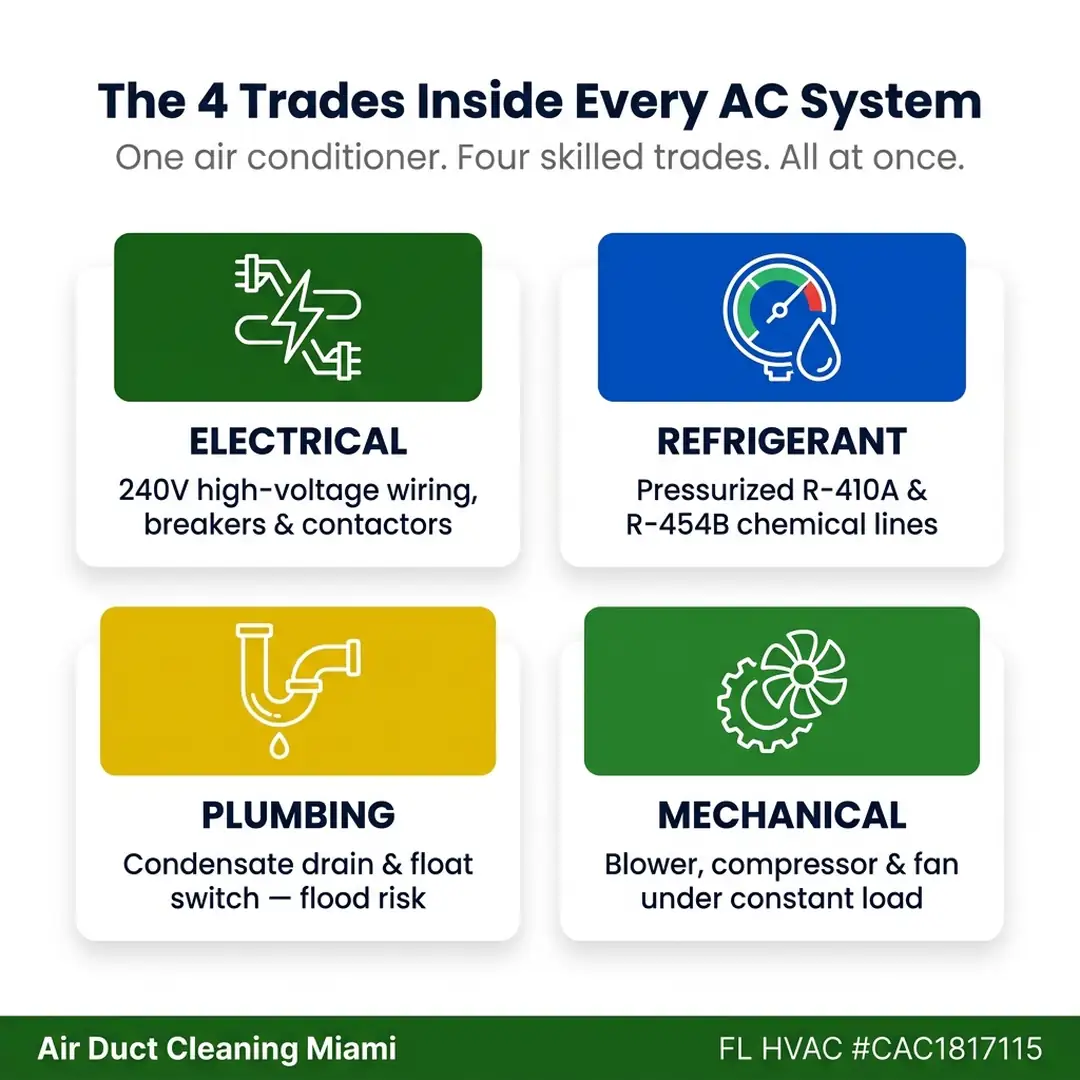
Your AC is not one appliance — it runs four skilled trades at once. A licensed Florida HVAC contractor (CAC license) is tested and trained on all four.
Your AC Runs Four Skilled Trades at Once
Most people think of their air conditioner as one thing. It is not. A central AC system combines four distinct skilled trades under a single unit, all operating inside your home simultaneously. A licensed Florida HVAC contractor (CAC license) is tested and trained on all four. An unlicensed “side guy” may understand one or two — and the gaps are where things go wrong.
1. Electrical
Your AC system runs on high-voltage current — typically 240 volts at the condenser, with 120-volt circuits for the air handler and controls. Incorrect wiring, loose connections, or oversized breakers create fire and shock risk. Every electrical component — the contactor, capacitor, disconnect, and compressor terminals — has to be correctly sized, correctly wired, and correctly protected. This is not low-voltage thermostat work. It is the same skill set an electrician uses.
2. Chemical — Refrigerant
Refrigerant is the working fluid that moves heat out of your home. It circulates through sealed copper lines at pressures between 150 and 400 psi depending on the system and ambient conditions. When those connections are not made correctly by a trained, licensed pro, a line can fail and release refrigerant inside an enclosed space. Refrigerant vapor can displace oxygen in a confined area — a recognized safety hazard documented in manufacturer guidelines and industry safety standards.
The newer A2L refrigerants, including R-32 and R-454B (sold as Puron Advance), add a layer on top of that. Per ASHRAE safety classifications and manufacturer guidance, A2L refrigerants are mildly flammable. Improper handling by an untrained person is not just an environmental violation. In the wrong conditions, it can create a fire risk inside your home.
Handling any refrigerant also requires federal EPA Section 608 certification — separate from the Florida state license, and with no dollar-amount exception. An unlicensed person recharging your system is violating both state and federal law at the same time.
3. Plumbing — The Condensate Drain
When your AC cools the air, it pulls moisture out of it. That moisture collects in a drain pan and flows through a condensate drain line to the outside. If the drain line is installed with the wrong pitch, gets clogged, or is missing a safety float switch (a shutoff that kills the system when the pan fills), the overflow goes into your walls, ceiling, or attic insulation.
In attic and closet installs — common across Miami-Dade and Broward — a condensate overflow can cause water damage that runs into thousands of dollars before you notice it. A safety float switch is a simple part. A licensed tech installs it as standard. An unlicensed tech may not know to.
4. Mechanical — Moving Parts Under Load
The blower motor, compressor, fan blades, and belt drives are all mechanical components operating under continuous load. Correct refrigerant charge (measured with calibrated gauges, not estimated), correct airflow (cfm matched to the duct system), and correct blower speed settings protect both the system and the occupants. Overcharged refrigerant causes liquid flood-back that can destroy a compressor. Undercharged refrigerant causes the evaporator coil — the cold metal part inside your air handler — to freeze and then flood the drain pan when it thaws.
Each of these four trade areas has its own failure mode, its own training requirement, and its own way of causing serious property damage or safety risk when it goes wrong. Florida’s contractor licensing requirement exists because the state recognizes all four of them as skilled trade work that requires demonstrated competency and insurance behind it.
Four Skilled Trades, One System — Make Sure the Person Touching It Is Licensed
Electrical, refrigerant, plumbing, mechanical — all at once. We hold FL HVAC #CAC1817115 and full insurance. Book a free licensed inspection with no obligation to book.
The Legal Side: Yes, It’s a Crime in Florida
The four-trades danger is why the law exists. Here is what it actually says.
Florida requires a CAC license (Certified Air Conditioning) issued by the Florida Department of Business and Professional Regulation, or DBPR, to legally perform HVAC or AC work for compensation. Getting one requires passing a state exam, carrying insurance, and completing continuing education requirements. This is Chapter 489, Part I of the Florida Statutes — the Construction Industries Licensing Act.
The penalties under FS 489.127:
| Offense | Classification | Maximum Jail | Maximum Fine |
|---|---|---|---|
| First offense | 1st-degree misdemeanor | 1 year | $1,000 |
| Repeat offense | 3rd-degree felony | 5 years | $5,000 |
| During State of Emergency | 3rd-degree felony (even first offense) | 5 years | $5,000 |
The State of Emergency provision matters in South Florida. Governor’s hurricane declarations are common from June through November. If an unlicensed contractor works on your AC during a declared emergency, they face felony exposure even on a first offense.
One more piece worth knowing: Florida Statute 489.128 makes an unlicensed contractor’s contract legally unenforceable. If your side guy does the work and then demands payment, he cannot take you to court to collect it. That sounds like a win — until you realize the work may already be done badly, the warranty is already voided, and you are the one living in the house with the result.
We hold Florida HVAC license CAC1817115, which you can verify yourself at myfloridalicense.com in about 30 seconds. BBB A+ rated. Anyone who works on your system should be able to say the same and back it up.
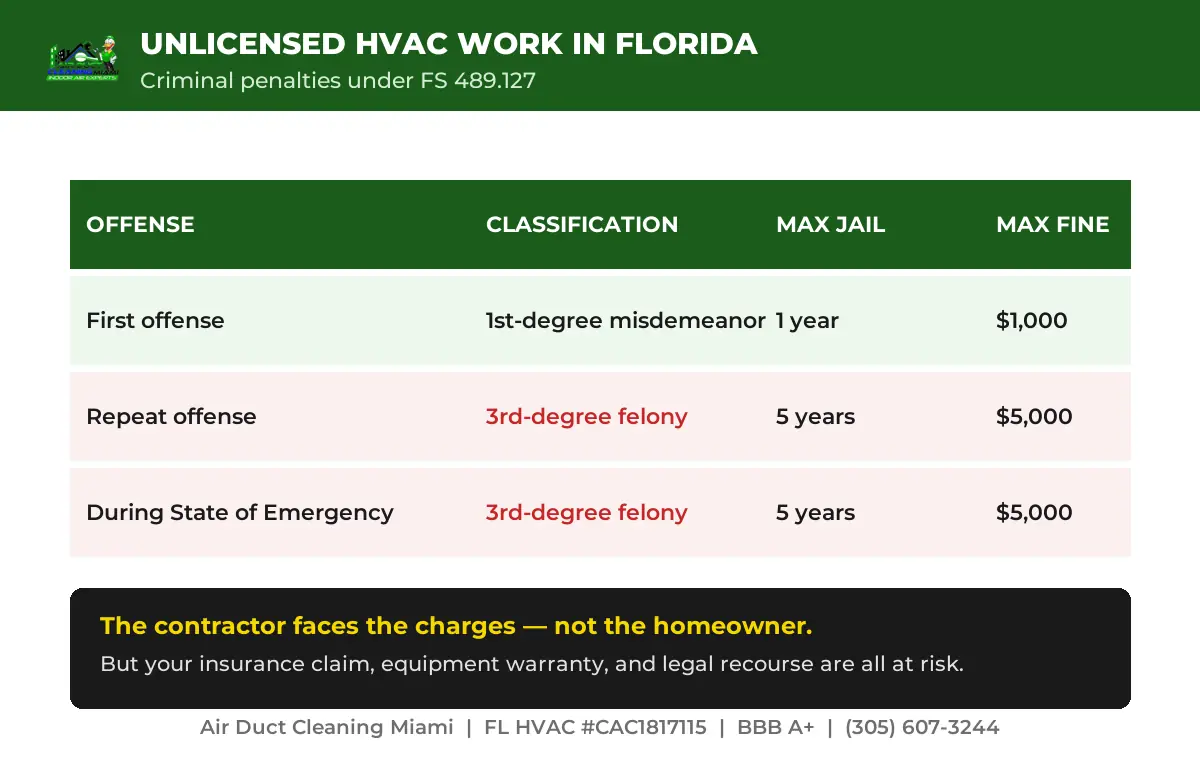
Criminal penalties for unlicensed HVAC work in Florida under FS 489.127 — the contractor faces the charges, but the homeowner carries the financial exposure.
What You Own When You Hire an Unlicensed Contractor
You will not go to jail for hiring the cheap guy. The crime under FS 489.127 is committed by the unlicensed contractor, not by the homeowner who hired them. But “not going to jail” is not the same as “no consequences.” As the homeowner, you own every result of that decision — financially, legally, and when it comes time to sell.
Your insurance will not pay. This is the consequence most homeowners miss, and it is the most expensive one. When an unlicensed contractor causes water damage, mold, a refrigerant leak, or a fire, your homeowner’s insurance investigates how the work was done. When they confirm it was unlicensed, they deny the claim. This is not fine print — it is standard in most homeowner’s policies. We have seen it play out in Doral and in Hallandale Beach condos where unlicensed AC work led to mold growth, and the homeowner’s policy paid nothing. The mold remediation came entirely out of pocket.
For condo owners, the exposure is even larger. When an AC leak damages a shared hallway, a neighboring unit, or a high-value building interior, and the work was done by someone without a license, the insurance denial can extend far beyond your own unit. When the number reaches into the hundreds of thousands in building damage, “I hired someone on Facebook” is not a defense your insurer will accept.
Your manufacturer’s warranty is voided. Carrier, Trane, Lennox, Goodman, Rheem, Daikin, Mitsubishi — every major manufacturer’s warranty requires work to be performed by a licensed HVAC contractor. An unlicensed install or repair voids that warranty the moment it happens. You may not discover this until the compressor fails two years later and the warranty claim is rejected on grounds that the service was not done by a licensed contractor.
You are liable if the worker gets hurt. Licensed contractors carry worker’s compensation and general liability insurance as part of their licensing requirements. Unlicensed workers typically carry neither. If an unlicensed person slips off your roof in Coral Springs, falls from a ladder in Aventura, or suffers heat stroke in your attic in Pembroke Pines, you may be financially responsible for their medical costs. You invited them onto your property; without their own coverage, the liability sits with you.
You have no legal recourse if the work goes wrong. The DBPR complaint process, the contractor bond, the right to arbitration — every formal protection in the licensed-contractor framework exists to protect you when work is done wrong. Step outside that framework and you step outside all of it. If the job is botched, you cannot file a DBPR complaint against someone with no license, and there is no bond to file against. If a botched job damages your system, our licensed AC repair in Miami team can assess what an inspection actually covers — and what it costs to put right.
The liability follows you even after you sell. If an AC unit was installed or serviced without a license and the problem surfaces years later — after you have sold the home — you can still be held accountable. A unit that fails, causes damage, or presents a safety hazard to the next occupant does not reset liability when the deed transfers.
The Permit and Resale Trap
Unlicensed AC work almost never includes a permit. And that permit gap has a way of showing up at the worst possible moment: when you try to sell your home.
When a buyer’s inspector or the title company discovers that an AC unit was installed or replaced without a permit, the transaction stalls. The buyer wants it resolved. The seller has to either retroactively permit the work or disclose it as an unpermitted installation — which affects the home’s value and the buyer’s ability to get financing on certain loan types.
Here is the practical problem: no HVAC company will pull a permit for work they did not perform. If the original installation was done by an unlicensed person with no permit, there is no clean path to retroactive permitting. The unit may need to be inspected, re-permitted, or in some cases replaced entirely to satisfy code — and the homeowner, not the unlicensed contractor who took the cash and disappeared, bears that cost and that delay. Code-enforcement liens are also possible, and those fines follow the property, not just the owner who authorized the work.
An Unlicensed Repair Can Cost More Than the Whole System Is Worth
Voided insurance, dead warranty, a blocked home sale years later. Our licensed team carries full insurance, holds FL HVAC #CAC1817115, and pulls permits when required. Get a free inspection today.
Or call (305) 607-3244 — same-day slots available
Dryer Vents, Duct Cleaning, and the Fire Risk Nobody Mentions
This is rising fast in Miami-Dade and Broward: carpet cleaners and general cleaning companies advertising dryer vent and duct cleaning as add-on services they are not qualified to perform.
Dryer vent cleaning done wrong is a fire risk. The National Fire Protection Association (NFPA) identifies lint accumulation in dryer vents as a leading cause of home fires. Proper dryer vent cleaning requires tools designed to extract lint from the full length of the vent run, not push it deeper. An untrained person who feeds a brush into the vent and drives lint further in — toward the dryer body — does not fix the problem. They make it worse. In older dryers that lack modern thermal cutoffs, a blocked vent means the dryer keeps running at elevated temperatures against trapped lint. That combination can and does start fires.
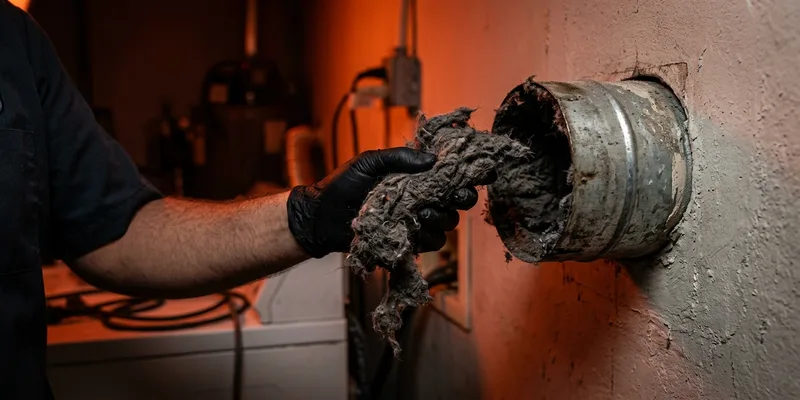
Lint packed into a dryer vent is one of the leading causes of home fires, per the NFPA. Done wrong, “cleaning” pushes lint deeper instead of extracting it.
Duct cleaning with the wrong products damages your system. Unlicensed operators buy coil-cleaning chemicals and duct treatment products at the hardware store. Many are not rated for aluminum coil fins, flex ductwork, or the interior lining of air handlers. The result: acid damage to coils, delamination of duct liners, and corrosion that creates refrigerant leaks over time. We are seeing a growing backlog of coil leaks across South Florida that trace directly back to unlicensed coil cleaning done with consumer-grade products.
The $99 Facebook ad is the door opener. The low price is not the service — it is the entry point. Unlicensed operators advertise $99 duct cleaning or $99 AC tune-ups to get through your door. Once inside, the upsell begins: coil cleaning, refrigerant charge, blower-motor service, full AC maintenance packages — services that require a CAC license they do not hold. The price goes up, the quality of work stays low, and the damage may not surface until weeks later when the compressor fails or the unit stops cooling.
The “Side Guy” Traps Miami Homeowners Fall Into
Carpet cleaners who became “HVAC cleaners.” A carpet-cleaning company adds duct cleaning to its menu, buys a kit, and starts advertising. The problem: they are cleaning blower motors without knowing how to disconnect and reinstall them, applying products not rated for HVAC systems, and leaving residue in the air handler that circulates through the home. When something goes wrong, they have no HVAC training, no license, no liability coverage for that work, and often no fixed business address to go back to.
Restoration companies doing AC replacement. A water-damage or mold-restoration company finishes a remediation job and offers to handle the AC replacement too, since the unit was already disrupted. Mold remediation and AC replacement are different licenses and different trades. A restoration company doing AC work without a CAC license is performing unlicensed contracting — the install may not be permitted, the warranty is voided, and the work is backed by nothing if it goes wrong.
The condo building maintenance guy. Specific to Miami-Dade and Broward high-rises, and one of the most common patterns we see. The in-building maintenance worker takes side money to service units — a little AC maintenance here, a refrigerant top-off there. He knows the building, he is accessible, the price is right. But at the end of the job he cannot give you a receipt with a valid CAC license number. That is the tell. No license number = no license — and every consequence above applies the same way.
We work in Miami-Dade and Broward every week. These are the patterns we see most often — not hypotheticals.
The Facebook Marketplace AC guy. Somebody posts in a local group offering tune-ups for $40 cash or freon recharges for $60. No company name. No license number. Pays in Venmo. The price looks good. The AC blows cold for two weeks — then develops a leak because the refrigerant was overcharged or the wrong refrigerant was mixed in with what was already in the system. Mixing refrigerants damages compressors. A new compressor on a mid-range Rheem or Carrier unit runs $800 to $1,500 installed.
“My cousin does HVAC.” The cousin took a few classes, worked for a company for a year, and now does jobs on the side with his own gauges. He may know more than a handyman — but “knowing some HVAC” is not the same as holding a state CAC license with insurance and a bond behind it. When his work causes a problem, there is no insurance to call, no license to pull, no bond to file against.
The unmarked white van with a generic business card. Seen all over Hialeah, Miramar, and North Miami Beach. The van shows up, the tech is friendly, the price is low. No truck branding, no license number on the van, no permit pulled for the work. When we show up six months later for a real inspection, we often find improper duct connections, unchecked drain lines, and refrigerant levels that were never actually measured — just guessed.
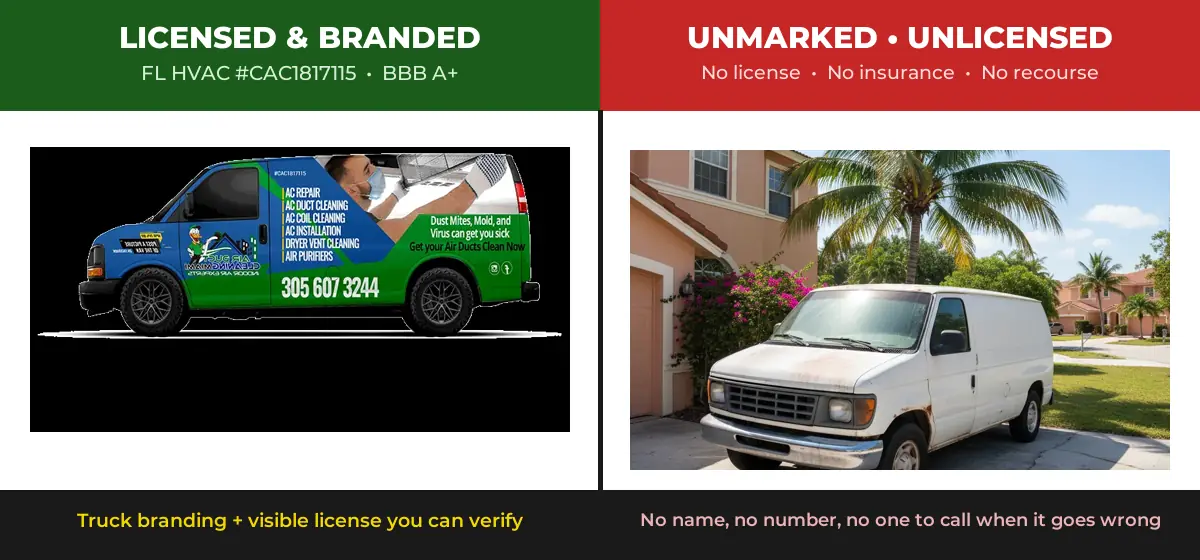
A branded, licensed truck you can verify versus an unmarked van with no name, no license number, and no one to call when the work goes wrong.
The “I just need freon” call. A homeowner calls asking for freon only, no inspection. Sometimes an unlicensed person offers to do just that — cheap. But if your system is low on refrigerant, something is leaking. Adding refrigerant without finding and fixing the leak is not a repair. It is a temporary fix that delays the real problem. A licensed tech will find the leak first. An unlicensed one often just fills it and leaves.
For a full breakdown of why hiring a handyman for AC work in South Florida is dangerous, including the specific refrigerant risks with newer systems, that post covers the technical side in depth. Staying ahead of problems with licensed AC maintenance plans for South Florida homeowners also keeps an unlicensed “quick fix” from ever being the tempting option.
A Simple Job Can Turn Into a Serious Hazard
One thing that draws homeowners toward unlicensed operators is the idea that the job they need is small. A capacitor swap. A refrigerant top-off. A duct cleaning. A dryer vent cleaning. How dangerous could it be?
Any of those jobs can create a hazardous situation when done without proper training. Bypassing a safety switch to “get the unit running” removes the protection that switch was installed to provide. Removing a blower motor without properly documenting the wiring and reinstalling it correctly creates a fire hazard. Running an AC system with the wrong refrigerant charge — over or under — stresses the compressor in ways that can cause sudden mechanical failure. Installing a capacitor at the wrong rating can damage the motor it is meant to protect.
We know of cases in Florida where a fan motor or blower motor was not hooked up correctly. The unit ran for a couple of days — then caught fire. These are not freak events. They are what happens when electrical work inside an AC system is done without training. And when the danger happens, unlicensed operators do not answer the phone. They are not bonded, they carry no insurance, and there is no license to file a complaint against. The homeowner is left with the fire investigator, the insurance adjuster, and a policy that may deny the claim because the work was unlicensed.
How to Verify a Contractor’s License Before They Touch Your System
This part is short because we have already built a complete guide for you.
Go to myfloridalicense.com, enter the contractor’s name or the license number they give you, and confirm the CAC license is active, not expired, not revoked, and held in their name. It takes 30 seconds.
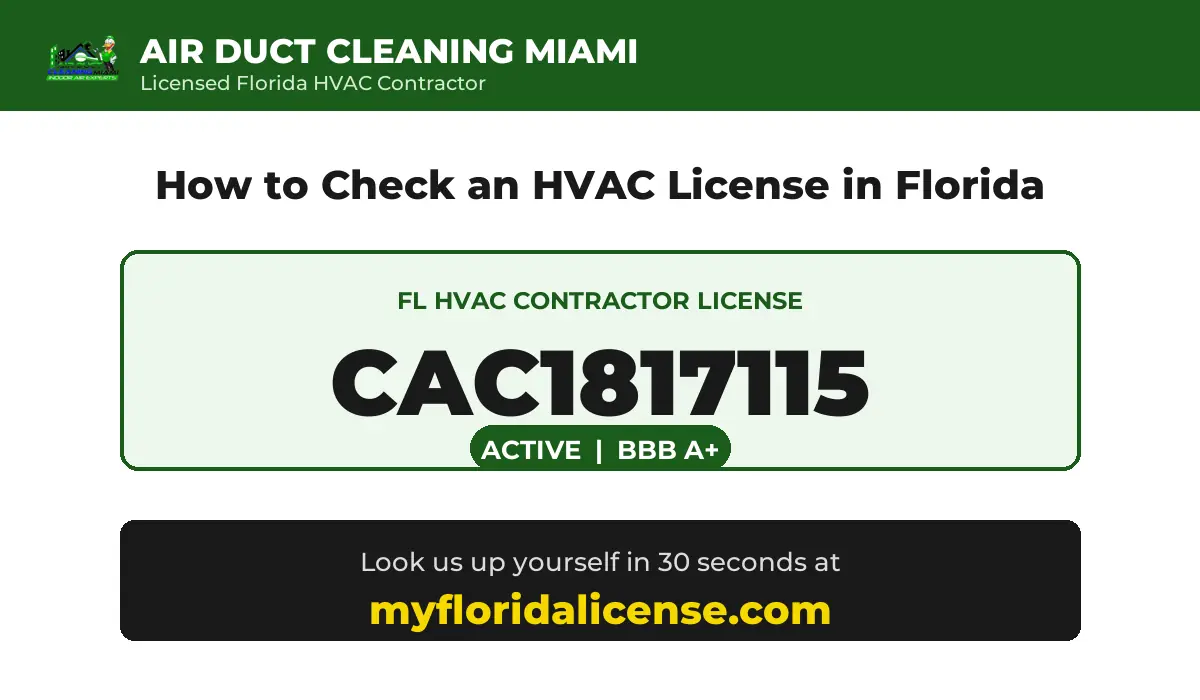
Verify any Florida HVAC contractor in about 30 seconds. A valid contractor carries a CAC license — ours is CAC1817115. Look it up at myfloridalicense.com.
For the full step-by-step process — including what to do if the name doesn’t match, how to spot a borrowed license number, and what questions to ask before you book — see our guide on how to choose a licensed AC contractor in Miami. And if you want to do the lookup yourself right now, our guide to the 30-second DBPR license lookup for Miami homeowners walks you through it screen by screen.
We are Air Duct Cleaning Miami — Florida HVAC license CAC1817115, BBB A+, 1,000+ homes served across Miami-Dade and Broward. You can look us up at myfloridalicense.com before you book. We want you to.
How to Report an Unlicensed HVAC Contractor in Florida
If you hired someone you now believe was unlicensed — or if a neighbor is using an unlicensed contractor and you want to file a report — here is how:
DBPR complaint (FS 489.127 investigation): File online at myfloridalicense.com. The DBPR has investigative authority under FS 489.127. Provide the contractor’s name, business name if known, the address where the work was done, and any documentation you have (invoices, texts, photos).
Florida Attorney General: Call 1-866-9NO-SCAM or file online at MyFloridaLegal.com. The AG’s office handles consumer protection complaints and coordinates with DBPR on unlicensed contractor enforcement, especially after hurricane season when unlicensed work spikes.
If you suffered actual damages from unlicensed work — botched repairs, water damage, mold growth from improper installation — consult a Florida attorney about your civil options. FS 489.128’s unenforceability clause may be relevant to any contract you signed. When unlicensed work has already led to mold inside walls or ductwork, our mold remediation after unlicensed HVAC damage team handles the cleanup the right way.
Related Reading
Before you call anyone for AC work, take five minutes with these:
- How to choose a licensed AC contractor in Miami — the 7-question vetting guide
- Why hiring a handyman for AC work in South Florida is dangerous — the refrigerant and chemical risk explained
- Licensed AC repair in Miami — what a licensed inspection includes
- Mold remediation after unlicensed HVAC damage — when unlicensed work leads to mold
Air Duct Cleaning Miami has served 1,000+ homes across Miami-Dade and Broward. Every job is performed under Florida HVAC license CAC1817115 with full insurance. If you have questions about what licensed AC service looks like — or if you want to verify a contractor before you commit — call us at (305) 607-3244. No pressure, no sales pitch.

Get a Licensed Inspection From a Team You Can Verify
Don’t let an unlicensed repair void your insurance and kill your warranty. FL HVAC #CAC1817115 • BBB A+ • Same-day available.