

AC Not Removing Humidity? Why Your Miami Home Still Feels Sticky
It’s 6:30pm in Hollywood. Your AC has been running since you got home, the thermostat says 74, and the air still feels like wet laundry sitting on your skin. The floors are tacky. Your hair won’t dry. The bathroom mirror is fogged 20 minutes after a shower. Your AC is cooling — but it isn’t pulling the humidity out, and that’s a different problem than “AC not cooling.” If your Miami home or condo feels sticky even when the AC is running constantly, the most common cause is an oversized unit that short-cycles before it can dehumidify, followed by a dirty evaporator coil, low refrigerant, or a thermostat fan stuck on “ON” instead of “AUTO.” In this post we’ll walk you through the 7 real reasons your AC isn’t removing humidity in Miami, what each one looks like, what’s at risk if you ignore it (mold, warped floors, ruined drywall), and when to call a licensed FL HVAC pro before the damage starts.
Why humidity matters more than temperature in South Florida
Most homeowners think their AC has one job: blow cold air. It actually has two: cool the air and pull moisture out of it. Down here, the second job is the harder one. Outdoor humidity in Miami sits at 70–90% from May through October. Your AC is supposed to drop indoor relative humidity to 45–55%. That’s the comfort zone. Above 60% indoors, the room feels muggy even at 72°F. Above 65%, you’re in mold territory. Day in, day out, we walk into Aventura condos and Pembroke Pines homes where the thermostat reads 73 but the hygrometer reads 68%, and the homeowner can’t figure out why they’re still sweating in their own living room.
Here’s the kitchen-table version: your AC is basically a dehumidifier that also cools. The cold metal coil inside your indoor unit (the evaporator coil) chills the air below its dew point, water condenses on the coil like beads on a cold beer can, then drips into a pan and out the drain line. If anything breaks that process (cycle too short, fan running too long, refrigerant low, drain backed up), the moisture stays in your house. Cooling and dehumidifying are tied together. Lose one, you usually lose the other.
Sticky Air in Your Home? Get a Free Diagnostic.
Licensed FL HVAC pros (#CAC1817115) check coil temp, refrigerant, drain line, and sizing. Same-day service across Miami-Dade and Broward.
The 7 real reasons your AC isn’t removing humidity in Miami
1. Your AC is oversized (the #1 cause in Miami homes)
This is the most common cause we see, and almost nobody guesses it. When a contractor installs a 4-ton unit in a home that only needs 2.5 tons, the AC blasts the room cold in 8 minutes, hits the thermostat setpoint, and shuts off long before it had time to wring water out of the air. Then the room warms up, the AC kicks on, blasts again, shuts off. That’s called short-cycling. The room reads cool but feels swampy.
Properly sized AC units run longer cycles at lower output, which is exactly what dehumidification needs. If your AC turns on and off every 10 minutes and your house still feels damp, the equipment was sized wrong from day one. The fix isn’t a bigger AC — it’s the right-size AC, ideally with a variable-speed compressor. Talk to a pro about a properly sized AC installation using Manual J load calculations, not a “rule of thumb.”
2. Dirty evaporator coil
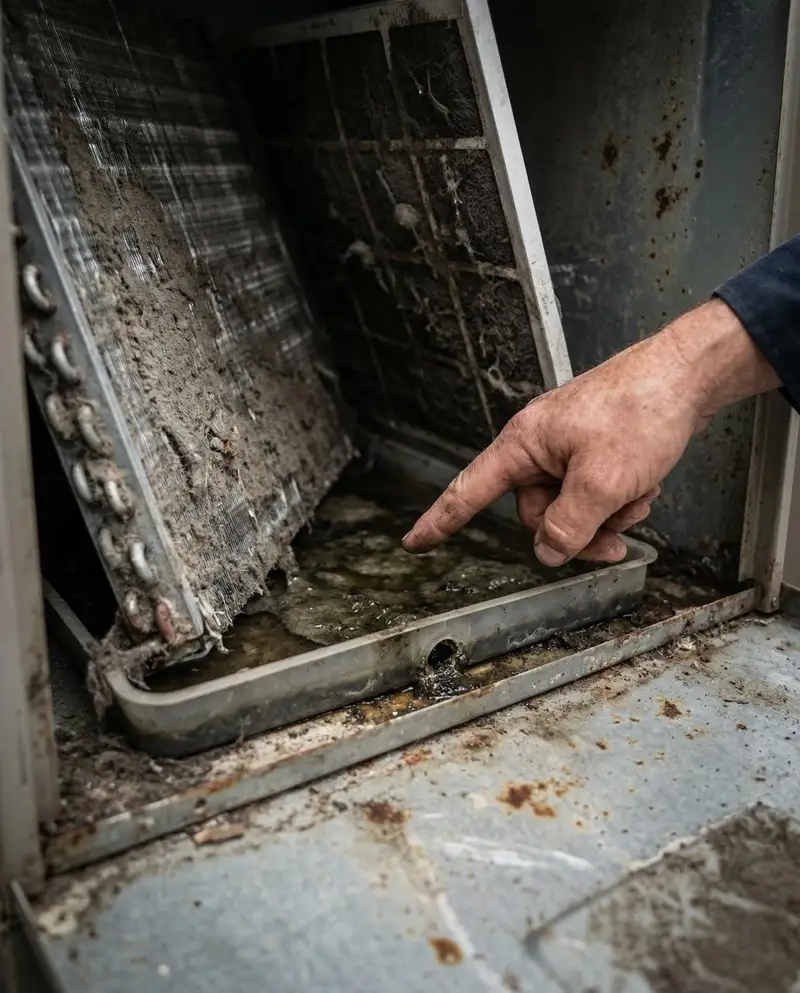
Remember the cold beer can analogy? If the coil is coated in dust, pet dander, and biofilm, water can’t condense on it efficiently. Air still gets cooled, somewhat. But the moisture stays floating around your living room. In Miami, coils get dirty fast because we run AC 9–10 months a year and most homeowners never open the air handler.
You’ll usually see this paired with weak airflow at the vents and higher electric bills. Coil cleaning isn’t a DIY job. It requires pulling panels, sometimes removing the coil, using non-acidic foaming cleaners, and rinsing without flooding the drain pan. We do this as part of evaporator coil cleaning on most maintenance visits. Not sure if your coil is the problem? Our guide on signs your AC coil needs cleaning lists the specific symptoms to watch for in Miami homes.
3. Low refrigerant or a slow leak
Refrigerant is what makes the coil cold. Low refrigerant means a warmer coil, which means less condensation, which means humidity stays in the air. A slow leak develops over years. The system limps along cooling 70% as well, dehumidifying 40% as well, and the homeowner doesn’t notice until summer hits hard.
Refrigerant work is EPA-regulated. Anyone touching it needs an EPA 608 certification. If a “handyman” offers to top off your freon for $200 cash, that’s the warning sign — they’re not licensed, they’re not catching the leak, and you’ll be calling someone six weeks later. See our professional AC repair page for what a real diagnosis looks like.
4. Thermostat fan set to “ON” instead of “AUTO”
This one is free to fix and we mention it first on every humidity service call because so many people get caught by it. On your thermostat there’s a fan switch. “AUTO” means the blower runs only when the AC is actively cooling. “ON” means the blower runs 24/7, even when the compressor is off.
Here’s why “ON” wrecks humidity in Miami: when the AC cycles off, water is still sitting on the cold coil and in the drain pan. If the fan keeps blowing, it evaporates that water right back into your house. You just re-humidified the air you spent money to dehumidify. Switch your fan from ON to AUTO. Right now. Walk over and check. This alone fixes 1 in every 8 humidity calls we get.
5. Clogged condensate drain line
The water your AC pulls out of the air has to go somewhere. It runs through a small PVC drain line out to the side of the house, or in a condo, into a pan that drains to the building system. In Miami’s humidity, that drain line grows algae and biofilm fast. When it clogs, water backs up into the pan, the pan fills, and a float switch shuts the AC off — or worse, the pan overflows into your ceiling.
Even before it overflows, a backed-up drain means standing water inside the air handler. That water re-evaporates into the air, drives humidity back up, and starts growing mold. We’ve cleaned ducts in Hollywood and Surfside condos where the only “leak” was a drain that nobody flushed for 5 years, and the mold bill was over $10,000. See why Miami homes get mold in air ducts for the full chain.
6. Frozen evaporator coil
If your indoor coil freezes into a solid block of ice (caused by low airflow, dirty filter, dirty coil, or low refrigerant), two things happen: first, no air gets through, so cooling collapses; second, when the AC shuts off and the ice melts, all that water dumps into the drain pan at once, overflowing it and re-humidifying your house. You may notice ice on the refrigerant lines, water around the air handler, or the AC blowing room-temp air after running for hours.
⚠ If you see ice on your AC: stop and call
Turn the AC OFF (not just the thermostat — flip the breaker), let it thaw 4–6 hours, then call. Running it frozen burns out the compressor, and a compressor replacement is the most expensive single repair on a residential AC. Background on the related symptom: why is my AC leaking water?
7. The system is over 12 years old
AC units in Miami get punished. Salt air on the coast (Surfside, Sunny Isles, Miami Beach) corrodes coils. Constant runtime wears compressors. After year 12, dehumidification capacity is the first thing to drop, usually before cooling starts to fail noticeably. The homeowner thinks “it still cools, it’s fine” while humidity creeps up and the house starts to feel different.
Modern variable-speed systems pull 30–50% more moisture per kWh than a 2010 single-stage unit. If your system is pre-2014 and you’re fighting humidity in a house that didn’t used to feel this way, the unit is telling you it’s near the end. We can do a load calc and walk you through replacement options without pressure. See AC replacement cost in South Florida.
Find Out Why Your AC Won’t Pull the Humidity
Same-day diagnostic across Miami-Dade and Broward. Free, no obligation to book.
Or call (305) 607-3244. Most calls answered in under 2 rings.
What’s at risk if you ignore high indoor humidity
This isn’t comfort-only. In Coral Gables, Hollywood, and Miami Beach we’ve documented:
- Mold growth on drywall and behind baseboards. Starts at sustained 60%+ RH, visible within 2–3 weeks.
- Warped engineered hardwood and laminate. Moisture swells the planks, gaps appear, replacement costs $8–15/sqft.
- Musty smell that won’t go away even after duct cleaning, because the source keeps re-wetting.
- Allergy and sinus flare-ups. Dust mites and mold thrive above 60% RH.
- Higher electric bills. Your AC runs longer trying to compensate for moisture it can’t pull out.
- Mold inside the air handler and ducts. Turns into a $5,000–$50,000+ remediation if it spreads.
The Miami condo case we reference often — a $125,000 mold remediation in a Hollywood high-rise — started exactly this way: a clogged drain line nobody noticed, humidity creeping up over a single summer, mold in the wall cavities by fall. The HVAC bill at the start would have been $185.
How to tell which of the 7 is your cause (without guessing)
You can do three checks yourself in 2 minutes before calling anyone:
- Look at your thermostat fan setting. Is it ON or AUTO? Switch to AUTO.
- Check your air filter. Pull it out. If you can’t see light through it, replace it. Dirty filters cause 3 of the 7 problems above.
- Buy a $12 hygrometer at Home Depot or on Amazon. Place it in your main living area. If it reads above 60% with the AC running, you have a real humidity problem (not just “it feels muggy”).
If those three don’t fix it, the cause is inside the equipment (coil, refrigerant, drain, sizing, or age) and it needs hands-on diagnosis. That’s not a YouTube fix. Refrigerant requires EPA 608 certification. Coil cleaning requires partial disassembly. Drain clearing in a condo often requires HOA coordination. We carry the right tools, the certifications, and the insurance, and we’ve done this in 1,000+ South Florida homes.
Why our 31-point inspection finds the real cause fast
A “freon top-off” doesn’t fix any of the 7 causes above — it masks one and ignores six. Our diagnostic checks coil temperature, refrigerant pressures (suction and discharge), superheat and subcool, drain line flow, blower CFM, return airflow, thermostat wiring, and indoor RH at 4 points in the home. We also look at age and sizing, because if the system is wrong, no repair holds.
We’re a licensed Florida HVAC contractor (#CAC1817115), BBB A+ rated, and our techs are EPA 608 certified for refrigerant work. We service all of Miami-Dade and Broward, including Aventura, Hollywood, Pembroke Pines, Doral, Coral Gables, Miami Beach, Surfside, Hallandale Beach, Sunny Isles, Davie, Cooper City, and the rest. Our trucks carry parts for the most common humidity-related repairs so we usually fix the issue same visit.
Prevent it before it starts: a maintenance plan beats emergency repair
Most humidity problems are preventable. A scheduled AC maintenance plan catches dirty coils, slow refrigerant leaks, and clogging drain lines months before they cause comfort or mold problems. Twice a year is the right cadence in Miami’s climate: once before summer, once before winter. Customers on a maintenance plan call us 70% less for emergency repairs and the few that do call get priority same-day service.
If you’re already noticing the sticky air, don’t wait for the mold smell. Call now and we’ll get a tech out, often same day in Miami-Dade and Broward.
Don’t Let Humidity Turn Into a $10,000 Mold Bill
We’ve seen too many South Florida condos and homes go from “feels sticky” to “mold remediation” in one summer. Catch it now. Free estimate, no pressure, no upsells.
Frequently Asked Questions
Stop the Sticky Air Before Mold Starts — Call (305) 607-3244
Indoor humidity above 60% in Miami isn’t a comfort problem — it’s the early warning that something in your AC system is failing. The longer it sits, the more expensive the fix. Get a licensed Florida HVAC pro out, get the real cause diagnosed, and get it handled before it shows up as warped floors or a $10,000 mold bill.
Read the related guides on why your AC is running all day and not catching up, why your AC is leaking water, 10 reasons your AC isn’t cooling, and how to get your AC ready for Miami summer, and why your FPL bill is high when the AC runs constantly. Or call (305) 607-3244 for a free, no-obligation diagnostic.