

Is Your AC Ready for Summer? What Homeowners Need to Know (Full Guide 2026)

Summer in Miami is not a suggestion. It is a five-month assault of 95-degree heat, 85% humidity, and an FPL bill that makes you wonder if you left every door in the house wide open. Your air conditioner is the only thing standing between you and genuine misery — and if it has not been serviced since last year, you are gambling with your comfort, your wallet, and potentially tens of thousands of dollars in water damage.
Every June, our phones ring non-stop with the same desperate call: “My AC just stopped working and it’s 92 degrees in my house.” The emergency repair costs $500 to $5,000 for the unit alone. But that is not the real damage. We see $20,000 to $100,000 in property damage every summer from water leaks, mold, and flooding caused by neglected AC systems. All of it preventable. Every single dollar of it.
This is your complete pre-summer AC maintenance checklist — not generic internet advice, but 14 items from a licensed Miami HVAC contractor (License #CAC1817115) who sees what goes wrong in Miami homes every single summer. If you handle these now, you will save money, protect your home, and keep your family cool and safe all season. For a full breakdown of every reason why this matters, see our guide on 10 reasons to service your AC before summer in Miami.
Why Miami Summers Are Uniquely Brutal on AC Systems
Before we get into the checklist, you need to understand why South Florida is the hardest environment in the country for air conditioning. This is not an exaggeration. Miami’s climate creates a perfect storm of conditions that destroy AC systems faster than anywhere else in the United States.
- Your AC runs 16-20 hours per day from June through September. In northern states, AC systems run 6-10 hours per day. In Miami, your system is running nearly around the clock. That is triple the wear and tear, triple the mechanical stress, and triple the electricity consumption.
- Humidity is the real killer. Miami summers average 75-85% relative humidity. Your AC does not just cool the air — it has to remove massive amounts of moisture. This means the evaporator coil stays constantly wet, the drain pan is always full, and mold growth inside the air handler is almost guaranteed without proper maintenance.
- Salt air corrodes copper refrigerant lines. If you live anywhere near the coast — Miami Beach, Fort Lauderdale, Hollywood, Hallandale Beach, Aventura — salt in the air is actively corroding your outdoor condenser and copper line sets. This leads to refrigerant leaks that slowly kill compressors.
- Power surges from summer storms damage electrical components. South Florida averages 70-80 thunderstorm days per year, many of them carrying power surges that fry capacitors, contactors, and circuit boards. A single surge can take out a $300 capacitor — or a $3,000 compressor.
- Algae and mold thrive in the heat. Between April and August, drain lines clog with algae growth at an alarming rate. The warm, wet conditions inside your air handler are a perfect breeding ground for mold that spreads to your ductwork and into the air your family breathes.
The result? AC systems in Miami have a shorter lifespan and fail more often than anywhere else in the country. The average AC system lasts 15-20 years in moderate climates. In South Florida, 10-15 years is more realistic — and that is with proper AC maintenance. Without it, you are looking at 7-10 years before a major failure, and a $17,000 replacement bill.
The 14-Point Pre-Summer AC Maintenance Checklist
Go through this checklist now — not in June. April is the ideal month. By summer, every HVAC company in Miami-Dade and Broward County is running back-to-back emergency calls, wait times stretch to days, and rates spike. Here is everything you need to check, in order of priority.
1. Replace Your Air Filter (The #1 Cause of AC Failure)
This is the single easiest thing you can do, and it is also the single most neglected item that leads to AC failure. A dirty air filter restricts airflow, forces your compressor to work harder, drives up your electric bill, and can freeze your evaporator coil — all from a $10-$20 part you can change yourself in under two minutes.
The air filter is the number one cause of AC failure when not changed on time. A clogged filter does not just reduce airflow — it triggers a chain reaction: mold growth on the evaporator coil, blocked drain lines from debris, freeze-ups that damage the compressor, and increased allergens throughout your home. We see this constantly in homes across Kendall, Doral, Pembroke Pines, and Coral Gables.
During Miami summers, replace your filter every 30 days. Not every 90 days like the package says — that recommendation is for moderate climates where the AC runs part-time. Homes with pets should change filters every 2-3 weeks. Use a filter rated MERV 8-11 for the best balance of filtration and airflow. We offer a monthly filter replacement service because homeowners and business owners get busy and miss changes — and one missed month can start the chain reaction toward failure.
2. Condenser Acid Wash (Prevent a $2,800 Compressor Replacement)
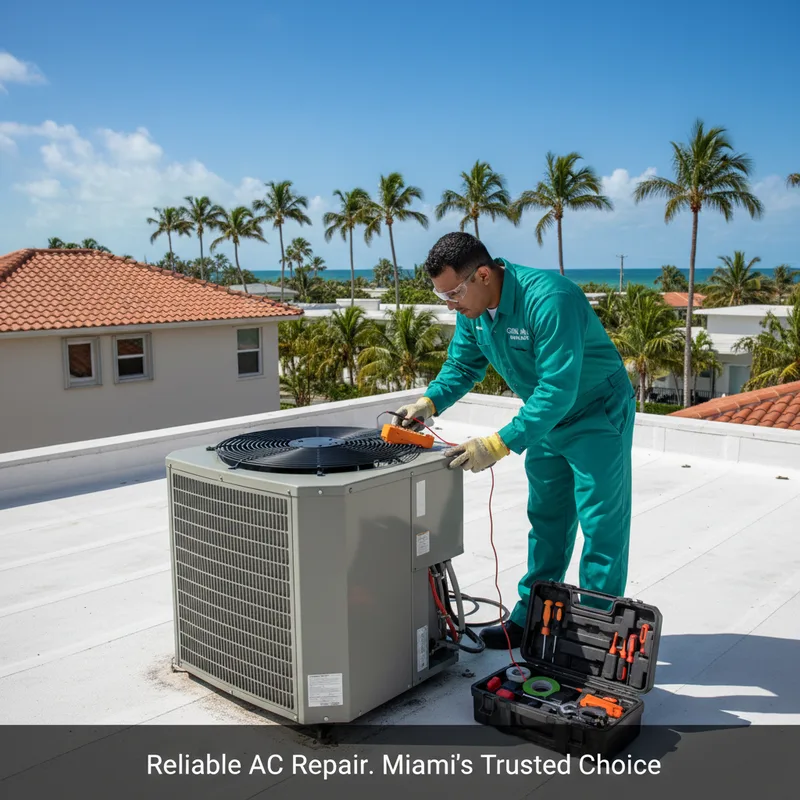
This is where most homeowners have a knowledge gap. Your outdoor condenser unit is where heat extraction happens — it is the part of the system that releases heat from the refrigerant into the outside air. When the condenser coil is dirty, the system cannot extract heat efficiently. The compressor overheats, burns its windings, and shorts out.
A dirty condenser coil leads to a $2,800 compressor replacement. It also doubles your FPL bill because the unit runs longer and harder trying to do the same job. Modern units with microchannel coils are especially vulnerable — these coils block up very frequently and need an annual acid wash to function properly.
This is not a DIY job. Improper cleaning bends the delicate fins and causes more problems. A professional condenser acid wash costs $150-$350 and should be done before the season starts. Compare that to a $2,800 compressor bill plus months of inflated electric bills from an inefficient system.
3. Evaporator Coil Cleaning (The Main Cause of Water Leaks)
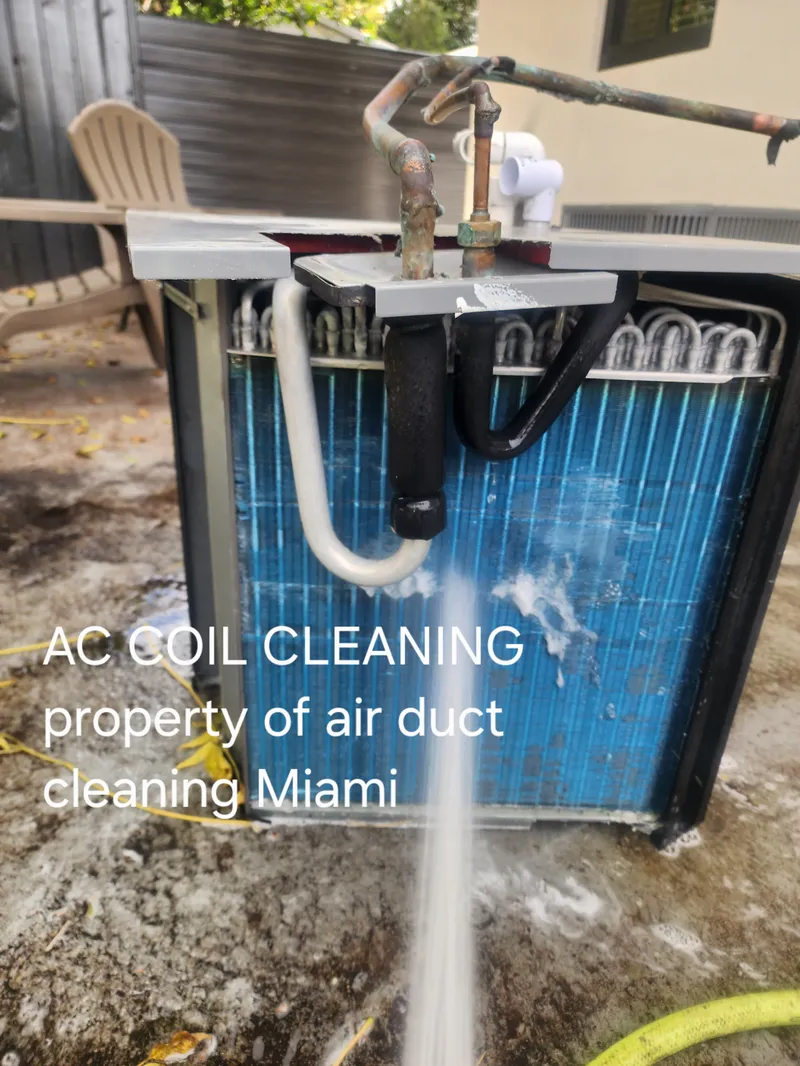
The evaporator coil is the indoor component located where you insert the air filter. This coil is the main cause of water leaks in Miami homes. When it is dirty, condensation does not drain properly, airflow is restricted, and mold begins growing on the coil surface.
Service your evaporator coil once a year before the summer rainy season — April is the time. This guarantees your AC lasts through summer without water leaks. If the coil is not cleaned, you face mold growth, freeze-ups, water leaks, limited airflow, and a doubled electric bill. The drain pan below the coil must also be cleaned and treated with anti-mold solution.
Without anti-mold treatment, mold grows on the coil, damages the surface, and forces more frequent cleaning. Eventually the coil deteriorates to the point where the entire AC needs replacement. A minor in-place evaporator coil cleaning is part of our premium maintenance package — a small investment that prevents catastrophic failure.
4. Drain Line Flush and Treatment (99% of Water Damage Is Preventable)
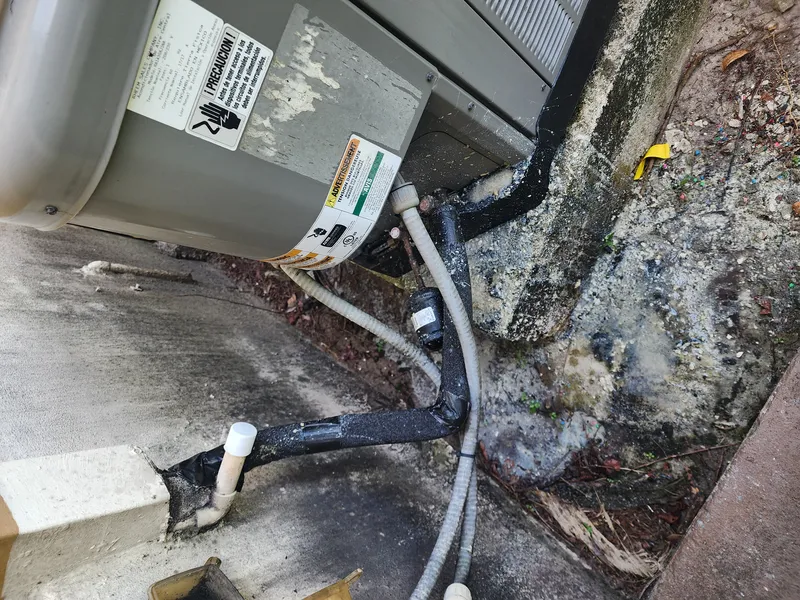
The condensate drain line is the PVC pipe that carries water from your indoor air handler to the outside. Between April and August in South Florida, this line gets blocked with algae and mold growth at a rate that surprises most homeowners. When it clogs, water backs up into the drain pan, overflows, and damages your ceiling, walls, flooring, and air handler.
99% of drain line water damage is preventable with proper maintenance. During a professional service, we flush the entire line, check the pitch to ensure proper drainage, inspect the trap, and apply anti-mold treatment. This is one of the most common and expensive problems we see every summer — and one of the easiest to prevent. If your system is already dripping or pooling water, our guide on why your AC is leaking water in Miami covers every possible cause and cost.
A drain line flush costs $75-$150. Water damage remediation from a clogged drain costs $5,000 or more. For condos in Aventura, Sunny Isles Beach, and Brickell, the stakes are even higher because a leak can damage units below you. During a professional AC tune-up, the drain line flush is included.
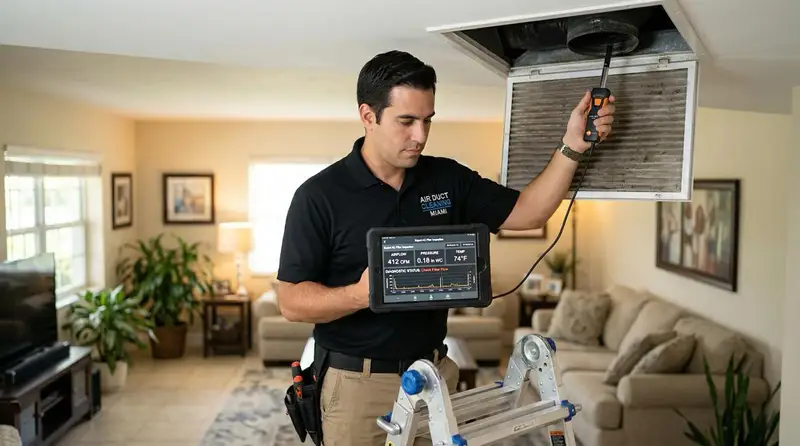
5. Check Your Thermostat Settings and Battery
If your AC is not responding when you adjust the thermostat, or takes too long to kick on, there may be a thermostat problem, a wiring issue, or a system failure. Check the batteries first, then verify it is properly hooked up and programmed for summer heat.
Program your thermostat for the highest heat load period — after 2 PM is when Miami homes need the most cooling. Set it to cycle on and off to save energy rather than running constantly. If you have an older manual thermostat, this is the perfect time to upgrade to a smart thermostat. A programmable thermostat can save Miami homeowners $100-$200 per year by automatically adjusting temperatures when you are away or asleep. Set it to 78 degrees when home and 82-85 degrees when away.
6. Anti-Mold Treatment (Do Not Skip This)
Anti-mold treatment is not optional in South Florida. It is a critical component of AC maintenance that many cheap service packages skip entirely. Without it, mold grows on the evaporator coil, inside the drain pan, along the drain line, and eventually spreads into your air duct system.
Once mold colonizes the ductwork, a simple coil cleaning is no longer enough — you need professional mold remediation that costs $800 to $3,000. Anti-mold treatment during a tune-up costs $150-$350 and prevents this entirely. It is included in our premium maintenance package for this reason.
7. 31-Point Professional Inspection (Catches What You Cannot See)
This is the most important item on this list. There are things you cannot check yourself: refrigerant levels, electrical component health, compressor amperage, blower motor performance, and internal coil condition. These are the components that cause the expensive failures.
Our 31-point inspection catches problems before they become emergencies:
- Burnt wires and bad capacitors — electrical failures waiting to happen
- Low freon levels — the number one compressor killer; we check and adjust (see our 2026 refrigerant cost guide if your system needs a recharge)
- Blower motor issues — amperage testing reveals motors about to fail
- Compressor performance — catches overheating before it burns out the windings
- Airflow measurement — identifies restrictions and duct problems
- Evaporator and condenser coil inspection
- Drain line flush with anti-mold treatment
- Thermostat calibration and system cycle test
- Complete safety inspection including circuit breaker
Book this in April. By June, wait times stretch to 3-5 days and rates go up. AC maintenance costs in Miami are a fraction of what emergency repairs cost during peak summer.
8. Circuit Breaker Check (Fire Safety)
Your AC circuit breaker needs to be checked every year, especially before summer. This is a fire safety issue that most homeowners never think about. During summer heat, the compressor draws heavy amperage. If the breaker is undersized or improperly installed, it can trip repeatedly — leaving you without AC — or worse, create a fire hazard.
Unlicensed individuals sometimes install incorrect or undersized breakers. This is dangerous. The breaker should match the compressor’s amperage requirements exactly. Voltage should also be checked — low voltage causes the compressor to work harder and overheat. This check is part of our 31-point inspection because it is that important.
9. Ductwork Inspection for Mold
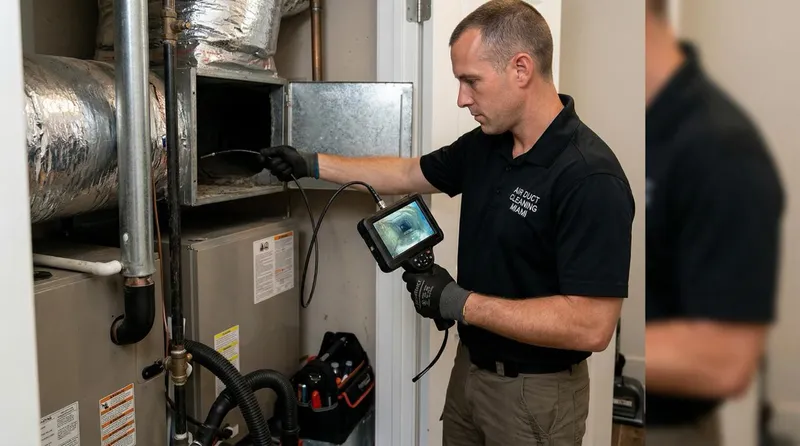
Your ductwork should be checked for mold every year. In Miami’s humidity, mold can develop inside ductwork even with a well-maintained AC system. If mold is found and limited to a small area, clean it immediately before it spreads. Once mold colonizes your entire duct system, you are looking at $800 to $3,000 in mold remediation costs.
In many Miami homes, ductwork also runs through attics where temperatures reach 140-160 degrees in summer. Check for obvious gaps, disconnected sections, or deteriorated insulation. Leaky ducts reduce cooling efficiency by 20-30% and dump cold air straight into your attic. A professional inspection and sealing can save $30-$50 per month on your FPL bill all summer. If you notice visible dust buildup or a musty smell from your vents, your air ducts need professional cleaning.
10. Float Switch and Flood Control (Critical for Condos)
A float switch is a small device that automatically shuts off your AC if water starts backing up in the drain pan. It costs $50-$150 to install. Without one, a clogged drain line will overflow silently until water damage is already severe.
For condos in South Florida, this is absolutely critical. A water leak from your AC can flood your unit and every unit below you. We have seen potential damages of up to a million dollars in condo buildings from a single AC leak without flood protection. If you live in a condo anywhere in Miami-Dade or Broward County — Brickell, Aventura, Hallandale Beach, Hollywood, Fort Lauderdale — check that your float switch is installed and working. If it is not installed, get it done before summer. This is non-negotiable.
11. AC Age Check and Replacement Timing
Find the manufacture date on your outdoor unit (it is on the data plate, usually on the side). If your system is 10+ years old, start planning for replacement. If it is 12-15 years old in Miami’s climate, you are living on borrowed time.
If your unit needs replacement, do it NOW — before summer. Here is why timing matters:
- Limited supplies in summer: Equipment distributors run low on inventory during peak season
- Code enforcement delays: Permit processing takes weeks to months when every contractor is filing simultaneously
- No AC for 1-3 months: Homeowners who wait can be stuck without cooling while waiting for equipment and permits
- 20-30% price increase: AC prices go up significantly in summer due to supply and demand — spring installation saves thousands
An emergency AC repair in July on a 14-year-old system is often a waste of money because another component will fail within months. Plan ahead, budget, and replace on your schedule instead of in a panic during a heatwave.
12. Inspect and Clean Your Supply and Return Vents
Make sure nothing is blocking your supply and return vents — no furniture, curtains, or rugs restricting airflow. Blocked vents create pressure imbalances that force your system to work harder and can cause uneven cooling throughout your home. Vacuum the vent covers and check for visible dust or mold.
13. Consider a Surge Protector for Your AC
South Florida’s summer thunderstorms produce constant power surges. A whole-home surge protector or a dedicated AC surge protector costs $100-$300 and can save you from a $3,000 compressor replacement caused by a single lightning-induced power surge. If you do not have one, ask your HVAC technician about it during your tune-up.
14. Clear the Area Around Your Outdoor Condenser
Walk outside and look at your condenser unit. It needs at least 2 feet of clearance on all sides. Trim back any bushes, remove leaves, pull away any patio furniture or stored items. A condenser choked with vegetation or debris cannot release heat efficiently. Your system runs longer, works harder, and wears out faster. This is a 10-minute task that directly impacts your cooling capacity and electric bill.
The Complete Cost Comparison: Prevention vs. Emergency
This is the table every Miami homeowner needs to see. Every single item on the left column prevents the catastrophic cost on the right. We are not guessing — these are the exact scenarios we see play out in South Florida homes every summer.
| Maintenance Item | DIY or Pro | Prevention Cost | Emergency Repair Cost |
|---|---|---|---|
| Air filter replacement | DIY | $10-20/filter | $500+ frozen coil repair |
| Condenser acid wash | Pro | $150-350 | $2,800 compressor replacement |
| Evaporator coil cleaning | Pro | Included in premium | $500+ water damage |
| Drain line flush | Pro | $75-150 | $5,000+ water damage + mold |
| Anti-mold treatment | Pro | $150-350 | $800-3,000 mold remediation |
| 31-point inspection | Pro | $149 (our basic) | $500-5,000 emergency repair |
| Circuit breaker check | Pro | Included in 31-point | Fire risk + no AC |
| Duct inspection for mold | Pro | Included in 31-point | $800-3,000 mold remediation |
| Float switch install | Pro | $50-150 | $20,000-100,000 flood damage |
Look at those numbers. A float switch costs $50-$150. Skipping it in a condo can result in $100,000 in flood damage to your unit and the units below you. A $150 condenser acid wash prevents a $2,800 compressor replacement. A $75 drain line flush prevents $5,000 in water damage. The math is not even close.
Why Cheap Maintenance Packages Do Not Work
Every spring, discount HVAC companies flood Miami with $29 and $49 “tune-up” specials. Here is the problem: those packages do not include what actually prevents damage.
Proper AC maintenance is a combination. Evaporator coil cleaning plus drain line flush plus filter replacement plus anti-mold treatment. One without the others does not work. A cheap tune-up that only checks freon and changes a filter will not prevent a $5,000 water damage event from a dirty evaporator coil or a clogged drain line.
Water damage costs thousands. Cheap maintenance does not prevent it. When you compare a $99 comprehensive tune-up to a $49 basic check, the $50 difference is meaningless against the $5,000-$100,000 in potential damage that the comprehensive service actually prevents.
⚠ Insurance Warning Every Miami Homeowner Must Read
Your homeowner’s insurance may NOT pay for water damage caused by AC failure if maintenance was not performed on time. Insurance companies consider this negligence.
Additionally, the maintenance must be performed by a licensed professional with a CAC contractor license number on the receipt. Unlicensed work cannot be submitted to insurance for claims — period.
This is one of the most important reasons to use a licensed HVAC contractor for your maintenance. Not just for quality, but for legal and insurance protection. Our license number (CAC1817115) appears on every invoice and receipt.
What Happens When You Skip Pre-Summer AC Maintenance
We are not guessing about this. We see it every single year. Here is what a typical “bad summer” looks like for a Miami homeowner who skipped maintenance:
- June: Frozen coils from dirty filters. Compressor overworking because the condenser was never cleaned. Water leaks starting from clogged drain lines. Every tech in Miami-Dade is booked.
- July: Compressor failure from overheating — $2,800 repair. Capacitor burnout after a thunderstorm. Emergency service at premium rates with 3-5 day wait times.
- August: FPL bill $150+ higher than it should be from an inefficient system. Mold discovered in the air handler and ductwork. Health complaints from family members.
- September: Water damage discovered behind walls from a drain line that has been leaking for weeks. Insurance denies the claim because there is no record of professional maintenance. Remediation bill: $5,000-$20,000.
Total damage from a skipped $149 tune-up: $5,000 to $100,000. All preventable.
Mold growth is especially dangerous in Miami. If your drain line clogs and moisture builds up inside the air handler, mold in your air ducts can develop within 48-72 hours in South Florida’s humidity. Once mold colonizes the ductwork, you need professional mold remediation that costs thousands — and the health effects on your family in the meantime are serious.
Hurricane Season Starts June 1 — Prepare Your AC Now
Summer in Miami also means hurricane season. Your AC system is especially vulnerable during and after major storms. Power surges, flooding, debris impacts, and extended power outages all threaten your HVAC equipment.
We have written a complete guide on how to prepare your AC for hurricane season in Miami that covers everything from securing your outdoor condenser to protecting electrical components from surge damage. Read it now and handle both summer prep and hurricane prep at the same time. Before summer arrives, you can also take advantage of our free diagnostic — read our guide on how to get a free AC inspection in Miami so you know exactly what to ask for and what to expect.
Frequently Asked Questions
The Heat Is About to Hit — Book Your AC Tune-Up Now
$149 tune-up with 31-point inspection. Freon check included. Same-day service available across Miami-Dade & Broward. Licensed #CAC1817115.
Book Pre-Summer Tune-Up →