

AC Leaking Water in Your Miami Home? Stop the Damage Tonight (Before It Costs You $125,000)
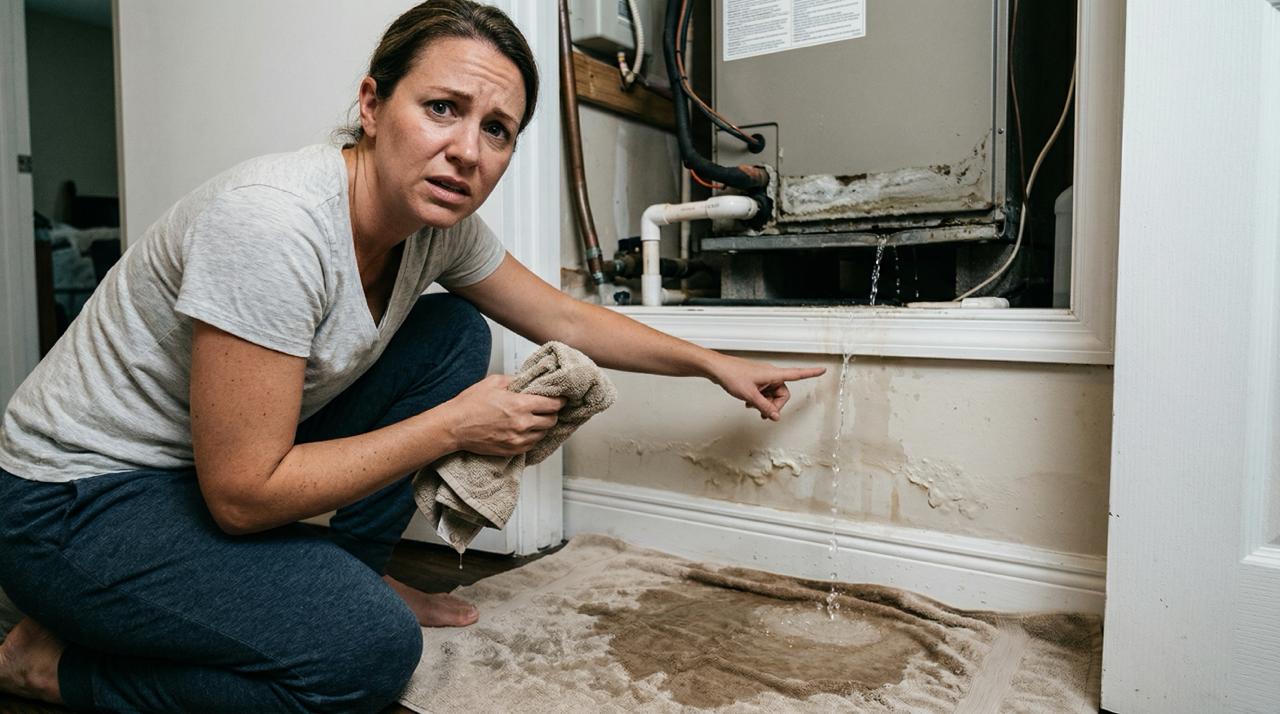
You hear it before you see it. A drip. Then a steady patter on tile. You round the corner into the laundry room and your stomach drops — water is spreading across the floor, the wall behind the air handler is dark and wet, and the ceiling tile below the unit is starting to sag. Your AC is leaking water, and if you are in a Miami condo, the next thought hitting you is the unit below.
Take a breath. You have time, but not much. In a Miami home, mold colonization can begin within 24-48 hours of water exposure — not the 72-hour window that drier climates quote. In a condo, you have a separate problem stacking on top: under Florida Statute 718, water damage that travels into the unit below is typically your liability, and condo-AC-leak cases in Brickell, Aventura, and Hallandale Beach have reached $125,000, $150,000, and even $250,000 in mold remediation and rebuild costs. This guide tells you what is actually leaking, the 5 most common causes in South Florida, exactly what to do in the next 30 minutes, and when "I'll deal with it tomorrow" becomes a financial mistake you cannot undo.
We have run AC water leak emergencies across all 19 cities in Miami-Dade and Broward — and the call we get most often starts the same way: "I should have called sooner." Read this now. Act now. (For the homeowner diagnostic checklist version of this topic, see the sister post: why is my AC leaking water in Miami.)
What Is Actually Leaking (Two Very Different Problems)
Before you panic, figure out which kind of leak you have. There are two. They look similar at first glance, and they have completely different outcomes.
Condensate Water Leak (most common — about 95% of calls)
Your AC is a giant dehumidifier. In Miami's 73% average humidity, a typical 3-ton system pulls 10-20 gallons of water out of your indoor air every day. That water collects on the evaporator coil, drips into a drain pan under it, and exits through a small PVC pipe called the condensate drain line. When something in that path breaks, the water has nowhere to go but out — onto your floor, into your ceiling, or down your wall.
This water is clean (it is just dehumidified room moisture) but it causes the same drywall, flooring, and mold damage as any leak.
Refrigerant Leak (rare — about 5% of calls)
Refrigerant is the chemical in the copper lines that actually does the cooling. A refrigerant leak does NOT typically produce visible water inside the house — it usually shows up as ice on the copper lines outside or on the indoor coil, a hissing sound, and the AC blowing warm air. If you see water AND ice, the system likely froze, then thawed, and what you are mopping up is the meltwater. (For more on this overlap, see AC blowing hot air in Miami.)
Refrigerant handling is federally regulated. Only EPA 608 certified technicians can legally touch it.
The 5 Most Common Causes in South Florida (Ranked by Frequency)
1. Clogged Condensate Drain Line — The #1 Cause in Miami
This is behind roughly 70% of every AC water leak call we run across Hialeah, Doral, Hollywood, Pembroke Pines, Coral Gables, and Aventura. South Florida's heat and humidity turn the condensate drain line — a warm, wet PVC pipe in a 130°F attic — into a perfect environment for algae, mold, and biofilm. The slime grows until water can no longer move through the line. The drain pan fills up. Then it overflows.
What makes Miami different: Miami's calcium-heavy tap water combined with year-round AC use means our drain lines clog 3-4× faster than the same setup in Atlanta or Charlotte. Lines that should clear themselves every few years here clog every 3-6 months without preventive flushing.
- What you will see: Water pooling under or near the indoor air handler. Ceiling stain below an attic unit. Sometimes an overflow tray with standing water.
- Cost to clear: $100–$250 (professional drain line vacuum + treatment)
- DIY? A wet/dry vacuum at the outdoor drain port can sometimes pull a clog. If that does not work in 30 minutes, stop — you may be looking at a cracked pan, broken pump, or refrigerant problem that DIY will not fix.
2. Frozen Coil That Thawed and Flooded
When your evaporator coil freezes (low refrigerant, dirty filter, blocked airflow), it builds up a thick layer of ice. The moment the system shuts off — or you switch the fan to ON to thaw it — that ice melts all at once. The drain pan, which is sized to handle a steady drip, gets dumped on with gallons of meltwater in a 20-minute window. Almost guaranteed overflow.
The telltale sign: you noticed the AC blowing warm air earlier today, you turned it off, and now there is water everywhere.
- What you will see: Sudden, large-volume leak. Ice visible on copper lines or indoor coil. Often paired with weak airflow before the leak started.
- Cost to fix: $150–$450 (coil cleaning + diagnosis). Underlying refrigerant issue adds $300–$1,400.
- What to do NOW: Shut the AC off completely. Place buckets and towels. Do not turn the fan back on until a tech inspects.
3. Cracked or Rusted Drain Pan
The drain pan sits directly under the coil. In coastal South Florida — homes within 5 miles of the ocean in Hollywood, Hallandale Beach, Aventura, Sunny Isles, Fort Lauderdale, Miami Beach — salt-air corrosion eats through metal drain pans in 8-10 years instead of the 15-20 they last in inland markets. Once the pan rusts through, water drips straight onto whatever is below — drywall, hardwood, tile, your downstairs neighbor's ceiling.
- What you will see: Slow steady drip directly under the unit. Rust stains on the floor or ceiling tile below. Visible corrosion on the pan if you can see it.
- Cost to fix: $200–$650 (drain pan replacement)
- DIY? No. Replacement requires removing the coil to access the pan.
4. Failed Condensate Pump (High-Rises and Basement-Level Units)
If your AC is in a closet without gravity drainage — which is the standard layout in Brickell condos, Aventura high-rises, Sunny Isles oceanfront towers, and any unit where the air handler is below the drain destination — a small electric pump pushes the condensate water up and out. When that pump fails (clogs, motor burns out, float switch sticks), water has nowhere to go and floods your closet, hallway, or downstairs neighbor's ceiling.
- What you will see: Water in or near the AC closet. Air handler running but no drainage sound. In high-rises, often paired with a complaint from the neighbor below.
- Cost to fix: $200–$500 (pump replacement)
5. Refrigerant Leak Causing Ice to Flood Cycle
Refrigerant does not get "used up" — if your system is low, it is leaking somewhere. As refrigerant drops, the evaporator coil gets too cold, ice forms, the system shuts off, the ice melts, and you get a flood. This is the underlying cause of many "frozen coil" calls.
- What you will see: Combination of warm air at vents, ice on lineset outside, hissing sound near the unit, gradually-worsening cooling over days or weeks, then a sudden flood.
- Cost to fix: $300–$1,400 to find and repair the leak + $250–$650 to recharge.
- DIY? No. EPA 608 certification required by federal law to handle refrigerant.

What to Do RIGHT NOW (30-Minute Action Plan)
If water is actively leaking from your AC as you read this, follow these steps in this order:
- Turn the AC OFF at the thermostat. Set it to OFF — not just up a few degrees. Every minute the system runs with a clogged drain produces another cup of water.
- If the water is anywhere near outlets, the breaker panel, or wiring, shut off the breaker. Water + electricity = lethal. Do not assume — assume the worst, kill the breaker.
- Place towels and buckets under the leak. Bring more towels. You will need them. Contain the water before it reaches more flooring or — in a condo — the unit below.
- Photograph and video everything. The source of the leak. The water spread. Damage to walls, ceilings, baseboards, flooring, furniture. Timestamp matters. Your insurance carrier and (if you are a condo owner) your association will require this.
- Try a drain line flush — but only if you have a wet/dry vacuum. Locate the outdoor PVC condensate drain port (a small white pipe usually near your outdoor unit). Attach the vacuum, run for 2 minutes. Then pour 1 cup of distilled white vinegar into the indoor drain access (the small Y-fitting near the air handler with a cap). Wait 30 minutes. If the leak slows or stops, you cleared it. Schedule a professional flush within 7 days — a partial DIY clear is a temporary fix.
- If the clog does not clear in 30 minutes — or if there is visible damage to the pan, the pump is silent, or you see ice — call a licensed HVAC tech. Do not "wait it out."
- If you are a condo owner: notify your association in writing within 24 hours. Email is fine, but follow up with certified mail or a written acknowledgment from the property manager. This protects you under Florida Statute 718.
Why You Have 24-48 Hours, Not a Week
This is the part nobody wants to hear. In Miami's climate, the standard advice from the rest of the country does not apply.
- Mold begins colonizing within 24-48 hours of water exposure on porous surfaces (drywall, baseboards, carpet padding, wood subfloor). Industry references that quote 72 hours assume 50% indoor humidity. Miami runs 60-75% indoor humidity for most of the year.
- Drywall wicks water vertically up to 12 inches in 4 hours. A leak you contained at the floor will be inside the wall by lunchtime.
- Insurance claims weaken every hour you delay. Carriers ask "when did you first notice the leak?" and then "what did you do about it?" A 6-hour gap between discovery and action is defensible. A 48-hour gap with no documented mitigation effort is how claims get reduced or denied.
We have personally inspected three South Florida condo cases that started exactly like the one you may be looking at right now:
- A $125,000 Aventura condo case — drain line clog, ignored for 3 days, full mold remediation across 4 rooms.
- A $150,000 Brickell case — failed condensate pump, water traveled 2 floors down, double-unit rebuild.
- A $250,000 Hallandale Beach high-rise case — slow ceiling leak from a unit upstairs, hard ceiling rebuild plus mold remediation across multiple units.
Every one of those started with a homeowner thinking "I'll deal with it tomorrow."
If you live in a high-rise condo
Your liability clock started the moment the leak began. Document everything, notify the association in writing within 24 hours, and get a licensed tech on site today. Call (305) 607-3244.
Condo Owners: This Is a Different Problem
If you own a unit in Brickell, Aventura, Sunny Isles, Hollywood, Hallandale Beach, Fort Lauderdale, or any high-rise tower in Miami-Dade or Broward, an AC water leak carries risk that single-family homeowners do not face: damage to the unit below you.
Miami high-rises are typically built with shared vertical drain risers. Your condensate line dumps into a stack that serves multiple units. When your line clogs, water finds the path of least resistance — and that path often runs through your floor into your neighbor's ceiling.
Under Florida Statute 718 (the Florida Condominium Act), you are typically liable for damage caused by your unit's AC system. Your HO-6 condo policy covers your interior. Your neighbor's HO-6 covers their interior. The association master policy covers common elements. When your AC floods their bedroom, you are the defendant.
What protects you:
- A documented maintenance history (twice-yearly tune-ups, drain flushes, pan inspections)
- An itemized invoice from a licensed Florida HVAC contractor (CAC license number on the paperwork — for vetting tips, see how to choose a licensed AC contractor in Miami)
- Photos and timestamps of every step from discovery to repair
- Written notification to your association within 24 hours
- A condensate float switch installed (auto-shuts the system if the pan fills) — small parts cost, massive insurance protection
For our condo-specific service breakdown across high-rise buildings, see air duct cleaning in Aventura.

Is AC Water Damage Covered by Insurance?
In Florida, homeowners and condo (HO-6) policies typically split AC water leaks into two categories:
"Sudden and accidental" — a drain line that breaks, a pan that fails without warning, a pump that dies overnight. Usually covered, subject to your deductible.
"Gradual damage from deferred maintenance" — a drain line that has been slowly clogging for months, water stains that appeared weeks ago, a pan with visible rust you never replaced. Typically denied.
The single biggest factor in whether your claim pays: maintenance records. If you can show twice-yearly licensed-tech visits with itemized invoices, your claim is much harder for the carrier to dispute. If you have nothing — no invoices, no service history — adjusters classify the damage as preventable and pay nothing.
When we respond to a leak call, we document everything in the service report — the cause, the condition of the drain line, the age of the pan, and photos of what we replaced. Keep these reports. Your adjuster will request them.
How to Prevent the Next Leak
Most AC water leaks in Miami are 100% preventable with three habits:
- Twice-yearly maintenance — once before summer (March/April), once mid-season (July/August). A tune-up includes a drain line flush, pan inspection, float switch test, and refrigerant pressure check. Catches a slow clog before it overflows. See AC maintenance in Miami.
- Install a condensate float switch. Around $75–$150 part + labor. Auto-shuts your AC when the pan fills, before water hits the floor. The single best ROI item on this list, especially for condo owners.
- Change your filter every 30-60 days. Restricted airflow leads to a frozen coil leads to a flood. Cheapest insurance you can buy.

Frequently Asked Questions
In Miami, yes. Mold colonization begins within 24-48 hours of water exposure due to our humidity (60-75% indoor average). For a single-family home, the urgency is property damage and mold prevention. For a condo, the urgency is also liability — water that travels to the unit below makes you the defendant under Florida Statute 718. Call (305) 607-3244 for same-day response.
No. Turn the system off at the thermostat immediately. If water is anywhere near outlets, breakers, or wiring, also kill the breaker. Running the AC during a leak amplifies water output and risks electrical shorts, motor damage, and rapid mold growth.
Across all 19 cities we serve in Miami-Dade and Broward, our standard promise is tech on the way in 60 minutes or less, with booking confirmed in under 60 seconds. Same-day service 7 days a week. After-hours emergency response available. Book emergency AC repair online.
Drain line clearing: $100–$250. Drain pan replacement: $200–$650. Condensate pump replacement: $200–$500. Coil cleaning (frozen-coil cause): $150–$450. Refrigerant leak repair: $300–$1,400 plus recharge $250–$650. Our $89 flat-fee diagnostic identifies the cause and is credited 100% toward the repair if you book the same day.
Sudden and accidental failures are usually covered (drain line break, pan failure, pump death). Gradual damage from deferred maintenance is typically denied. The single biggest factor: documented maintenance history. Carriers ask for service records. Twice-yearly tune-ups with itemized invoices from a licensed contractor strengthen any claim significantly.
Shut off the AC, contain the water, photograph everything, notify your association in writing within 24 hours, and contact your HO-6 carrier. Do not negotiate directly with the affected neighbor before involving your insurer. Maintain a documented service history — it is your strongest defense if a claim is filed against you.
No. A pan that fills repeatedly means there is an underlying problem (clog, crack, pump failure) that will not fix itself. Continued operation risks electrical damage, mold, and — for condo owners — liability for damage to the unit below. The clog or failure is what needs fixing, not the pan.
The Bottom Line From a Licensed Miami Contractor
Water leaking from your AC is not "wait and see" weather in Miami. The 24-48-hour mold clock is running, the drywall is wicking water inside the wall by lunchtime, and if you are in a condo your liability clock started the moment the leak began. The five causes above cover roughly 95% of what we see. Most are routine same-day repairs — if you call before water damage compounds.
(305) 607-3244 — call right now or book online. Tech on the way in 60 minutes or less.
Read Next
- Why Is My AC Leaking Water in Miami? 2026 Homeowner Checklist — sister diagnostic post
- AC Blowing Hot Air? 7 Reasons Your Miami AC Stopped Cooling — overlapping symptom (frozen coil)
- How to Choose a Licensed AC Contractor in Miami — vet your tech before you call
- Why Miami Homes Get Mold in Air Ducts — downstream consequence