
When Your Sunrise FL AC Stops Keeping Up in Summer: The 4 Most Common Failures and What They Really Mean
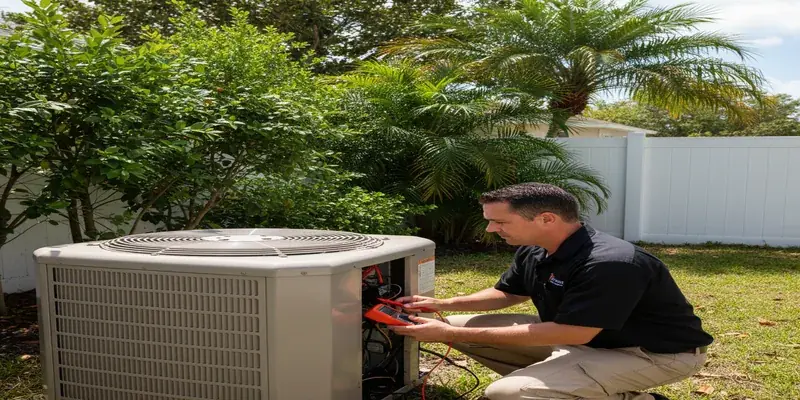
Your Sunrise FL AC repair need this summer probably started the same way it does for most homeowners in Springtree, Welleby, or anywhere along the Sawgrass Mills corridor: the house hit 81 degrees at 2pm, the system had been running non-stop since 8am, and it just was not catching up. In South Florida, where your air conditioner runs 18 to 22 hours a day from June through September, summer does not just stress your AC system. It surfaces every weakness that has been building quietly all year. This post walks you through the 4 most common summer AC failures we see in Sunrise homes, what is actually breaking inside the unit, what the repair costs look like, and what you need to know before calling a technician so you can make a confident decision rather than a panic one. We are licensed Florida HVAC contractor #CAC1817115, BBB A+ accredited, and we have worked on hundreds of Broward County homes just like yours.
Why Sunrise FL Homes Are Especially Vulnerable in Summer
Sunrise is not like Miami Beach or Brickell, where most residents live in condos with newer HVAC systems installed during the condo boom. Sunrise is predominantly single-family residential. Neighborhoods like Springtree, Welleby, and Sunrise Golf Village were built out heavily in the 1980s and 1990s. That means the homes are 25 to 40 years old, the original ductwork in many attics has degraded significantly, and a large percentage of the 2-ton and 3-ton Carrier, Trane, Rheem, and Goodman systems that were installed in the early 2000s are now hitting 15 to 22 years of continuous Florida service.
The average AC lifespan in South Florida runs 10 to 14 years. That is shorter than the national average of 15 to 20 years because of three climate factors that stack on each other here: extreme heat demanding near-constant runtime, humidity above 85% during the rainy season that accelerates coil corrosion, and salt air moving inland from the Atlantic that degrades outdoor condenser components faster than in inland or northern cities. When a unit installed in 2004 or 2007 hits a Broward summer in 2026, something almost always gives.
We see this pattern week after week in Sunrise. The system held together through the spring. Summer heat arrives, runtime jumps from 8 hours a day to 18, and the first week of June reveals exactly what the system has been hiding. Here are the four failures that account for the vast majority of the summer calls we take in this ZIP code.
Failure #1: The Run Capacitor Burns Out
Run Capacitor Failure
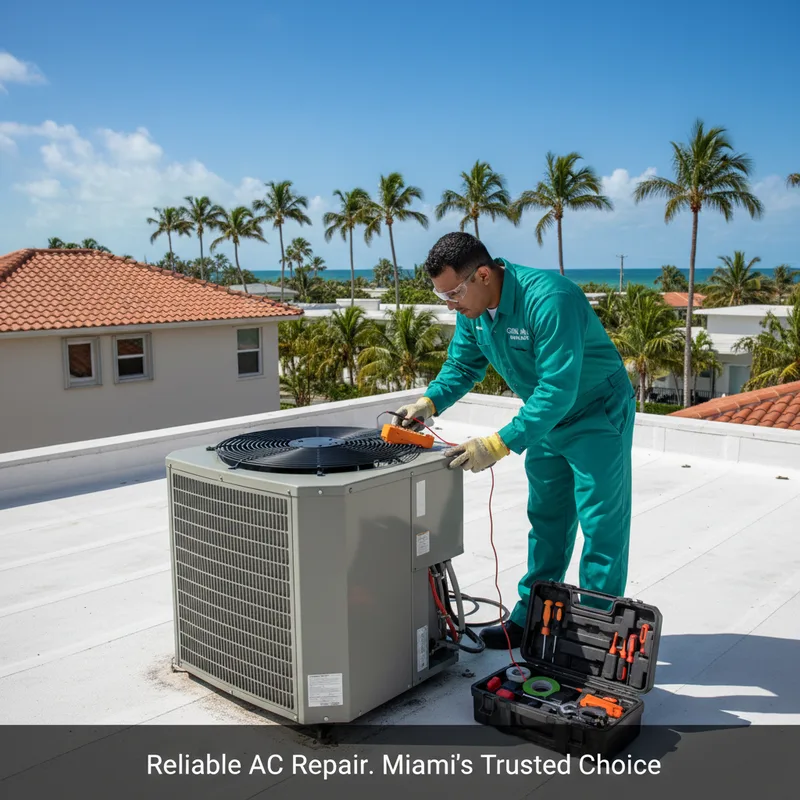
The run capacitor is a small cylindrical component, roughly the size of a soda can, that sits inside the outdoor condenser unit. Its job is to start and keep running the two motors in the outdoor unit: the compressor motor and the condenser fan motor. Think of it as the battery-like kick-starter that gets those heavy motors spinning and keeps them going under load.
Every summer in Florida, capacitors are the number one AC repair call. Here is why. Capacitors are rated for a specific voltage and temperature range. In Sunrise, where the outdoor condenser sits in direct sun on a concrete pad or roof, internal condenser temperatures routinely hit 130 to 140 degrees Fahrenheit during a July afternoon. At those temperatures, a capacitor that is already at 50 to 60 percent of its rated life will fail. It is not a matter of if. It is a matter of when in the summer cycle the heat finally overwhelms it.
The sign you will notice is that your outdoor unit starts but then sounds different. You may hear a humming sound from the condenser without the fan blade spinning. That is the compressor motor trying to start without the capacitor giving it the needed kick. In some cases the unit just shuts off entirely on a safety cutout.
What you should NOT do: do not open the outdoor unit yourself. Capacitors store an electrical charge even when the unit is powered off. A discharged capacitor can cause a serious shock. This is a licensed technician repair. A good technician carries replacement capacitors on the truck and replaces it in under 30 minutes. For context on what summer AC repair costs look like across the board, our complete AC repair cost guide for South Florida 2026 breaks down parts and labor by repair type.
Failure #2: Refrigerant Leak From an Aging System
Refrigerant Leak
Refrigerant (you may know it as "Freon," which is actually a brand name for older R-22 refrigerant) is the substance that circulates between your indoor evaporator coil and your outdoor condenser coil, absorbing heat from your home's air and releasing it outside. When the refrigerant level drops because of a leak, your AC stops being able to absorb heat effectively. The air coming from your vents feels cool but not cold. Or it feels almost normal but the house never reaches setpoint.
In Sunrise homes with systems from the 2000 to 2010 era, there are two refrigerant situations we see regularly. The first involves R-22 systems, which are now fully phased out of production. If your unit still uses R-22, recharging it means sourcing recycled refrigerant at prices that often make replacement the better financial decision. The second involves R-410A systems, which were the standard from roughly 2010 onward. R-410A is being phased toward R-454B under current EPA regulations, which is affecting parts availability and pricing on older systems.
Refrigerant leaks in aging South Florida systems typically happen at the evaporator coil connections or at the Schrader valves on the service ports. Fifteen years of Broward humidity accelerates the corrosion that causes these slow leaks. A technician can perform a leak test, locate the source, and quote you the repair-versus-replace calculation honestly. Critical point: EPA Section 608 certification is required by federal law to handle refrigerant. This is not a DIY repair, and a contractor who offers a refrigerant top-off without finding and repairing the leak is just taking your money. The refrigerant will leak out again within months.
If your system is losing refrigerant and it was installed before 2012, the honest conversation is whether repair makes financial sense versus a new high-SEER system. SEER (Seasonal Energy Efficiency Ratio) is basically a miles-per-gallon rating for air conditioners. A new system running at 16-18 SEER2 versus your aging 10-SEER unit will save $80 to $150 per month on your FPL bill in a Broward summer.
Is Your Sunrise AC Struggling This Summer?
We diagnose and repair AC systems across Sunrise, Plantation, Coral Springs, and all of Broward County. Free estimate, same-day service available. Licensed #CAC1817115 • BBB A+.
☎ (305) 607-3244 Schedule Free AC Diagnosis →Failure #3: Coil Freeze From a Dirty Filter or Restricted Airflow
Frozen Evaporator Coil
The evaporator coil is the cold metal component inside your indoor air handler unit, usually in the closet, attic, or garage. Its job is to get very cold so that warm air from your home passes over it, the heat gets absorbed, and cool air blows back through your vents. For that to work, there has to be steady airflow across the coil at all times. When airflow drops below a certain level, the coil gets too cold, moisture in the air freezes on its surface, and within hours you have a block of ice forming on your indoor unit.
In Sunrise homes during summer, frozen coils are the most common thing we see after capacitor failures. The most frequent cause is a dirty air filter. A filter that has not been changed in two or three months during heavy summer operation becomes so clogged that it chokes airflow to the coil. The coil then drops below freezing temperature and ice forms. Your vents feel weak, the house warms up, and sometimes water starts dripping from the air handler as the ice melts.
Here is what NOT to do: do not try to force-heat the coil or chip the ice off. The coil fins are thin aluminum and they bend easily. Turn the system to FAN ONLY mode (not OFF and not COOL) so the fan runs but the compressor does not. This lets the coil thaw over 2 to 4 hours. Then change your air filter. If the system freezes again after the coil is clean and the filter is new, the root cause is something else — usually a refrigerant issue or a failing blower motor — and a technician needs to diagnose it.
In older Sunrise homes, there is a second cause of restricted airflow we see constantly: degraded flex duct in the attic. The flex duct (the corrugated silvery tubing that runs from your air handler to each room's vents) has an insulating outer wrap that breaks down in a hot attic over 20 to 30 years. When the inner liner collapses or the duct separates at a connection, airflow drops throughout the system and the coil behaves as if the filter is clogged. This is a ductwork problem, not just an AC problem, and it affects your air quality too. For a full look at why your AC is not cooling despite running all day, that breakdown covers every cause from filter to refrigerant to ductwork.
Failure #4: Condensate Drain Backup
Condensate Drain Clog
Every air conditioner removes moisture from your home's air as part of the cooling process. In Broward County, where summer air can hold humidity above 80 percent, your AC pulls a significant amount of water out of the air every hour it runs. That water collects in a drain pan under the evaporator coil and flows out through a condensate drain line — a PVC pipe that exits through the wall or ceiling to the outside.
In summer, especially during the June-to-October rainy season, the combination of heavy humidity and near-continuous AC operation fills that condensate drain with water constantly. Algae, mold, and debris build up inside the drain line. When the line clogs, the drain pan fills. Most modern systems have a float switch in the drain pan that shuts the system down when water rises above a safe level. You come home to an 83-degree house and a blinking thermostat display — and the culprit is a clogged half-inch PVC pipe, not a failed compressor.
Preventive maintenance is the right answer here. Pouring a cup of diluted bleach or white vinegar into the drain pan access port every few months keeps algae from establishing. But if the line is already clogged and the system has already shut down, a wet-vac on the exterior drain line exit usually clears it. If that does not work, the clog is in the internal trap or the p-trap at the air handler, and a technician clears it properly in under an hour.
The more important point about condensate drain issues: water inside an air handler cabinet that is not draining creates a mold environment within 48 to 72 hours. A Sunrise home where the drain backs up repeatedly through summer is accumulating mold on the evaporator coil, in the drain pan, and potentially in the surrounding ductwork. That mold then circulates through every room every time the system runs. If you have had recurring drain backups, a professional coil cleaning and system inspection is worth doing before the end of summer. The guide to why your AC runs all day without reaching setpoint covers drain and humidity issues in the broader context of summer performance.
Get a Free AC Repair Estimate in Sunrise FL
Enter your ZIP code. We serve all of Broward County including Sunrise, Plantation, Tamarac, Lauderhill, and Coral Springs. Same-day appointments available — no obligation to book.
When Repair Makes Sense vs. When to Replace
This is the conversation most Sunrise homeowners dread because it involves real money. Here is how we approach it honestly.
A capacitor replacement on a 12-year-old unit that is otherwise running well is a smart $200 to $300 repair. That unit has life left in it. A refrigerant recharge on a 2003 R-22 system with a slow leak is a bad investment. You are spending $400 to $600 on refrigerant that will leak out again within a season, and you are delaying the inevitable replacement while your FPL bill stays high on an inefficient old system.
The rule of thumb most honest HVAC contractors use: if the repair cost exceeds 50 percent of the replacement cost, and the unit is over 12 years old, replacement is usually the better financial decision. A new 3-ton system for a Sunrise single-family home runs $4,500 to $7,500 installed, depending on the brand and SEER rating. Carrier, Trane, Rheem, and Bryant all make quality systems for the Florida climate. Goodman offers solid value at a lower price point. We can give you that honest repair-versus-replace analysis on-site before any work begins.
Why We Are the Right Contractor for Sunrise FL AC Work
We are not a franchise operation. We are not a carpet cleaning company that added HVAC as an upsell. We are a licensed Florida HVAC contractor (license #CAC1817115) specializing in AC repair and maintenance across Broward and Miami-Dade County. We carry EPA Section 608 certification for refrigerant handling. We are BBB A+ accredited. Our technicians are background-checked, uniformed, and arrive in branded service trucks stocked with the most common repair parts including capacitors in multiple sizes, contactor relays, refrigerant gauges, and drain cleaning equipment.
We service all system types common in Sunrise: central air split systems with indoor air handlers and outdoor condensers, heat pumps, and older package units. Brands we work on include Carrier, Trane, Rheem, Lennox, Bryant, Goodman, Ruud, York, Daikin, and American Standard. We have serviced hundreds of Broward homes, and we know the specific failure patterns of the 2000 to 2010 equipment that dominates the Sunrise and Plantation housing stock.
When your Sunrise home AC breaks in July, your margin for discomfort is thin. Indoor temperatures can spike past 90 degrees within hours on a July afternoon. We treat summer AC calls as urgent and same-day service is available. Air Duct Cleaning Miami is the licensed HVAC contractor Sunrise homeowners call when the system stops keeping up and they want a straight answer, not a sales pitch. Call (305) 607-3244 or book online now.
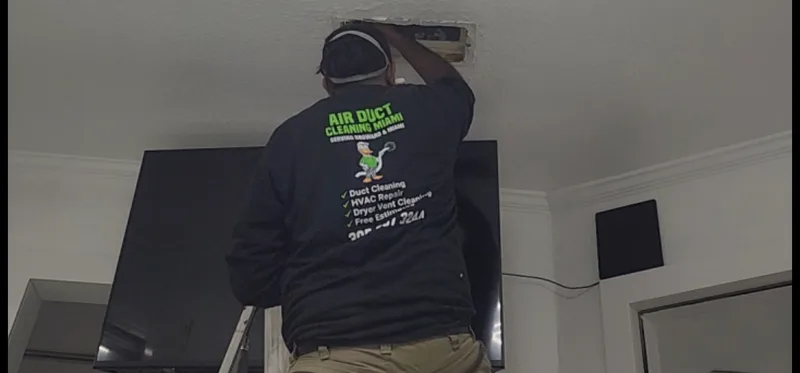
Same-Day AC Repair in Sunrise FL & All of Broward
Capacitor, refrigerant, coil freeze, drain clog — we diagnose and fix it today. Free estimate, no obligation to book. Licensed #CAC1817115 • BBB A+.
Book Free AC Diagnosis →Or call (305) 607-3244
Frequently Asked Questions
Your AC Needs a Licensed Contractor — Call (305) 607-3244
You started reading this because your Sunrise home hit 80-something degrees with the AC running full blast. Now you know exactly what is likely happening inside that system — and why a capacitor, a refrigerant leak, a frozen coil, or a clogged drain line each require a different approach. None of them are guesswork and none are something to delay in a July Broward summer.
If your AC is blowing warm air, call us now. If it shut down overnight and you woke up to 84 degrees inside, call us now. If it is running but just not keeping up, read our guide on AC blowing hot air in Miami and then call us. Our AC repair service covers all of Sunrise, Plantation, Tamarac, Lauderhill, Coral Springs, and the rest of Broward. Same-day availability. Free estimate with no obligation to book. Licensed. BBB A+. (305) 607-3244.