


What SEER Rating Do You Really Need for Florida’s Heat? (Miami Homeowner’s Guide)
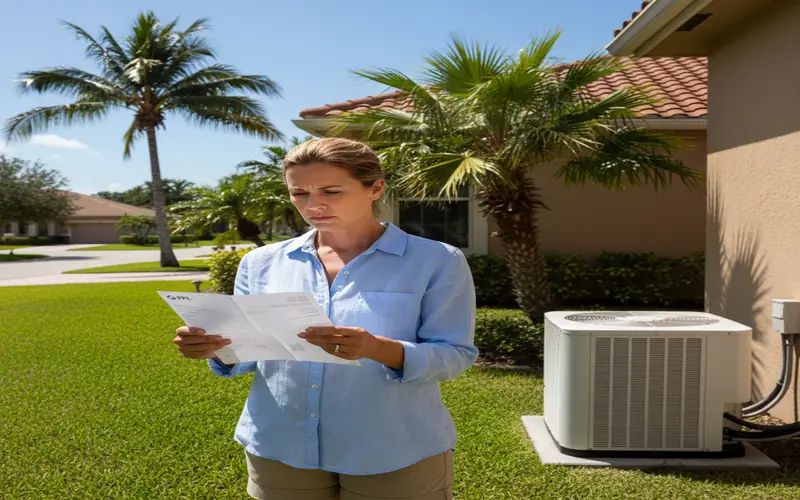
You asked your contractor about a new AC and they handed you a quote with “16 SEER2” on it. Or your FPL bill hit $380 in August and someone told you to check your SEER rating. Either way, you want to know what SEER rating you need in Florida — not a generic national answer, but a real South Florida number that actually makes sense for a home that runs AC ten months a year.
Here is the direct answer: in Miami-Dade and Broward County, the minimum legal SEER2 rating for a new AC installation is 15 as of January 2023, but we recommend 16 to 18 SEER2 for most homes. Florida’s heat and humidity mean your system works harder and longer than anywhere else in the U.S. — a higher efficiency rating pays itself back faster here than it does in Ohio. Licensed FL HVAC contractor #CAC1817115, BBB A+, 1,000+ South Florida homes served — here is how we explain it to every homeowner we work with.

Not Sure If Your AC Is Running Efficiently?
We check SEER ratings, refrigerant levels, and energy performance as part of every free diagnostic. Same-day availability across Miami-Dade and Broward.
Schedule Free AC CheckCall us: (305) 607-3244
What Is a SEER Rating?
SEER stands for Seasonal Energy Efficiency Ratio. It is the miles-per-gallon number for your air conditioner.
Here is the simple version: a higher SEER number means the unit produces more cooling per dollar of electricity. A 16 SEER system is more efficient than a 14 SEER system. A 20 SEER system is more efficient than a 16 SEER system. The math works out cleanly — going from 10 SEER to 20 SEER cuts your cooling costs in half.
The official formula: SEER = total cooling output during a normal cooling season ÷ total electrical energy input during the same period. In plain English, it measures how much cool air you get per kilowatt-hour of electricity you pay for.
Why SEER Matters More in South Florida
In a northern city, your AC runs maybe 4 to 5 months a year. In Kendall, Plantation, or Aventura, it runs 10 to 12 months. Every tenth of a point in SEER efficiency compounds across those extra months. A 2-SEER improvement that saves a northern homeowner $40/month saves a South Florida homeowner $80 to $120/month on the same square footage.
What Does SEER2 Mean? (The 2023 Change You Need to Know)
If you have been getting quotes in the last couple of years, you have seen “SEER2” on every piece of equipment. Here is what changed.
In January 2023, the U.S. Department of Energy updated how it tests and rates AC efficiency. The old SEER standard used a test that underestimated the resistance your system faces moving air through ductwork. SEER2 uses a more realistic test with 5 times the external static pressure (ductwork resistance), so it more accurately reflects your system’s real-world performance.
The practical takeaway: all new AC equipment sold today is rated in SEER2. Old SEER and new SEER2 numbers are close but not exactly equivalent. A 15 SEER2 unit is roughly equivalent to a 15.2 SEER unit under the old standard. When you see SEER2 on a quote, you are seeing the honest modern number.
If a contractor quotes you in old SEER, ask why
Equipment has been required to carry SEER2 ratings since January 2023. If a contractor is still quoting in old SEER without converting, they may be working with older inventory or not up to date on current standards. Always ask for SEER2 ratings when comparing equipment.
What SEER Rating Is Required in Florida?
Florida is in the U.S. Department of Energy’s Southeast region. The minimum efficiency standard for new residential AC installations in this region, effective January 1, 2023, is 15 SEER2.
Before January 2023, the Florida minimum was 14 SEER. That standard is now expired. Any licensed contractor installing a new system today must install equipment that meets 15 SEER2 at minimum. If a contractor tries to install a 14 SEER unit as new equipment in your home, they are out of compliance with federal efficiency regulations.
The minimum requirement is a legal floor, not a recommendation. It is the least efficient system a contractor is allowed to sell you. In South Florida, where your system runs nearly year-round, most homeowners benefit significantly from going above the minimum.
SEER 14 vs 16 vs 18 — What Is the Real Difference in Miami?
Numbers on paper only mean something when you translate them into dollars on your FPL bill. Here is how different SEER2 ratings compare for a typical 3-bedroom South Florida home (approximately 1,800 sq ft, running about 2,800 hours per year at 3.5 tons):
| SEER2 Rating | Est. Annual Cooling Cost* | vs. 15 SEER2 Baseline | Notes |
|---|---|---|---|
| 10 SEER (old unit) | ~$2,200/yr | — | Pre-2010 era system |
| 14 SEER | ~$1,700/yr | — | No longer legal for new installs in FL |
| 15 SEER2 (FL minimum) | ~$1,580/yr | Baseline | Legal minimum for new installs |
| 16 SEER2 | ~$1,480/yr | Save ~$100/yr | Best value sweet spot in South FL |
| 18 SEER2 | ~$1,320/yr | Save ~$260/yr | Payback within 4–6 years on upfront premium |
| 20 SEER2+ | ~$1,190/yr | Save ~$390/yr | Best for large homes, premium setups |
*Estimates based on FPL average residential rate of ~$0.14/kWh. Actual savings vary by home size, insulation, duct condition, thermostat habits, and equipment brand. Duct leaks can reduce effective SEER by 20-30% regardless of equipment rating.
The jump from 15 to 16 SEER2 typically adds $300 to $600 to the equipment cost. At $100 per year in savings, that pays back in 3 to 6 years — and most Miami-Dade systems last 12 to 15 years. Going from 15 to 18 SEER2 adds $800 to $1,500 upfront but saves $260 per year, with payback inside 6 years in most cases.
Thinking About Upgrading Your AC System?
Our licensed team handles AC installation across Miami-Dade and Broward County. We’ll recommend the right SEER2 rating for your home size, budget, and utility goals — and give you the honest numbers before any work begins.
What SEER Rating Do You Actually Need?
The honest answer depends on three things: how old your current system is, how long you plan to stay in your home, and your FPL bill tolerance.
If your system is 10 to 12 years old
You likely have a 10 to 13 SEER unit from the early 2010s. Replacing it with a 16 SEER2 unit cuts your cooling costs by 40 to 50 percent immediately. The payback on a full replacement is typically 5 to 8 years in South Florida just from energy savings — before you even factor in the repair bills an aging system accumulates.
If your system is 5 to 8 years old
You probably have a 14 or 15 SEER unit. Upgrading now is harder to justify on energy savings alone unless your current system is failing. Focus instead on keeping it properly maintained — dirty coils and clogged filters can drop your effective efficiency by 20 to 30 percent regardless of what the SEER rating says.
If you are building new or doing a full replacement
Go to at least 16 SEER2. In a South Florida climate that runs AC nearly year-round, the marginal cost difference between a 15 and 16 SEER2 system is small relative to the lifetime energy savings. We see the math play out in our AC repair vs replacement cost conversations every week.
Does Higher SEER Always Mean Better?
Not automatically. A few important caveats for South Florida homeowners:
SEER measures sensible cooling, not dehumidification. In Miami’s humidity, you also care about how well your system removes moisture from the air. A high-SEER system with a poorly matched air handler or oversized equipment can cool the air temperature quickly without pulling enough humidity out — leaving you with a cold, clammy house. AHRI-matched equipment (air handler and condenser rated together) matters as much as the SEER number.
Your ducts limit your real-world efficiency. A new 18 SEER2 condenser connected to a 25-year-old leaky duct system will perform like a 12 SEER unit in practice. Duct leaks in South Florida homes are common — we see them constantly in Hallandale Beach condos and older Kendall single-family homes. If your ducts have not been inspected in the last 5 years, address that before or alongside a new system purchase. Otherwise you are buying efficiency you will never experience.
Size trumps SEER. An oversized system — even a high-SEER one — short-cycles, meaning it turns on and off too frequently. Short-cycling is inefficient, wears out components faster, and does not dehumidify well. A properly sized system at 16 SEER2 will outperform an oversized system at 20 SEER2 in a real home.
When Should You Upgrade to a Higher SEER System?
Three clear triggers we see at Air Duct Cleaning Miami every season:
- Your FPL bill keeps climbing even though you maintain your AC. If you are doing everything right — cleaning coils, changing filters, annual tune-ups — and your bill is still creeping up, your system’s efficiency is degrading with age. Capacitors and compressors lose efficiency gradually before they fail.
- Your system is over 12 years old. Miami systems age faster than northern ones. Year-round runtime, salt-air corrosion on coastal properties, and Florida’s extreme summer demand all accelerate wear. After 12 years, the replacement math almost always wins.
- Your repair quote exceeds 40% of replacement cost. If a repair costs more than $1,500 to $2,000 on a system that is already 10+ years old, the money is better applied toward a new high-efficiency AC installation that immediately cuts your monthly bill and comes with a manufacturer warranty.
We give honest repair-versus-replace analysis on every service call. No pressure, no upselling. If your system has 5 good years left, we say so. If you are one compressor failure away from a $2,800 repair on a 14-year-old unit, we tell you that too — and show you the AC maintenance cost numbers that make the case clearly.

Get an Honest SEER & Efficiency Assessment
Licensed FL HVAC #CAC1817115 • BBB A+ • 1,000+ South Florida homes. We diagnose your current system’s real efficiency and give you the replacement numbers in writing before you decide.
Book Free DiagnosticAvailable same-day • (305) 607-3244
Frequently Asked Questions
In Florida, a good SEER2 rating is 16 or higher. While the legal minimum for new installations in the Southeast region is 15 SEER2 (effective January 2023), Miami-Dade and Broward homeowners run their AC 10 to 12 months a year. A 16 or 18 SEER2 system pays back the cost difference in energy savings within 3 to 5 years on a typical FPL bill.
As of January 1, 2023, the U.S. Department of Energy requires all new residential AC installations in the Southeast region (which includes Florida) to meet a minimum efficiency of 15 SEER2. This replaced the previous 14 SEER standard. Any contractor installing a new system below 15 SEER2 in Florida is violating federal efficiency rules.
No. First, SEER 14 is no longer legal for new installations in Florida as of January 2023 — the minimum is now 15 SEER2. Second, even if you had a 14 SEER unit already installed, Miami’s year-round heat and humidity mean you would be paying significantly more on your FPL bill every month compared to a modern 16 or 18 SEER2 system. The energy savings on a newer unit typically offset the cost difference within a few years.
SEER (Seasonal Energy Efficiency Ratio) was the old federal measurement standard. SEER2 is the updated standard the DOE introduced in January 2023 with a stricter test procedure that more accurately reflects real-world conditions. A 15 SEER2 unit is actually slightly more efficient than a 15 SEER unit under the old test — so the numbers are close but not exactly equivalent. All new AC equipment sold in the U.S. is now rated in SEER2.
Read Next
A high SEER number only pays off if the system is installed correctly. See what a proper air conditioning installation in Miami actually involves.