

How Often Should You Service Your AC in Miami? A Hialeah Homeowner's Schedule for South Florida Heat
How often should you service your AC in Miami? Twice a year, minimum — once in March or April before the summer ramp, and once in October or November after hurricane season winds down. South Florida runs its AC about nine months a year, so the national "once a year" rule does not apply to you. And it decides something you may not have connected to maintenance at all: your FPL bill.
Here is the pattern we hear in Hialeah every summer. You switch the AC off when you leave for work to save money, the bill comes in higher anyway, and the answer you get from the power company is that the AC has to work extra to cool your house back down. That part is true. What they cannot see from the meter is how much extra — and that is decided by how often you service the AC. A clean, correctly charged system recovers the house in under an hour. One nobody has looked at in a year grinds for three or four. Same thermostat, same afternoon, very different bill.
Below is the Hialeah homeowner's schedule month by month, the condo and single-family differences, hurricane-season timing, the early-warning signs that mean "call sooner," and the honest math on one-off tune-ups versus the annual plan.
Turning the AC Off to Save Money — Why the Bill Goes Up Instead
You leave at 7, you switch the AC off, and the house sits at 88 until you walk back in at 6. Then you set 76 and wait. The power company is right that the AC has to work extra to cool your house back down. But "extra" is not a fixed number. It is set by the condition of the equipment, and that is the part nobody at the utility can see.
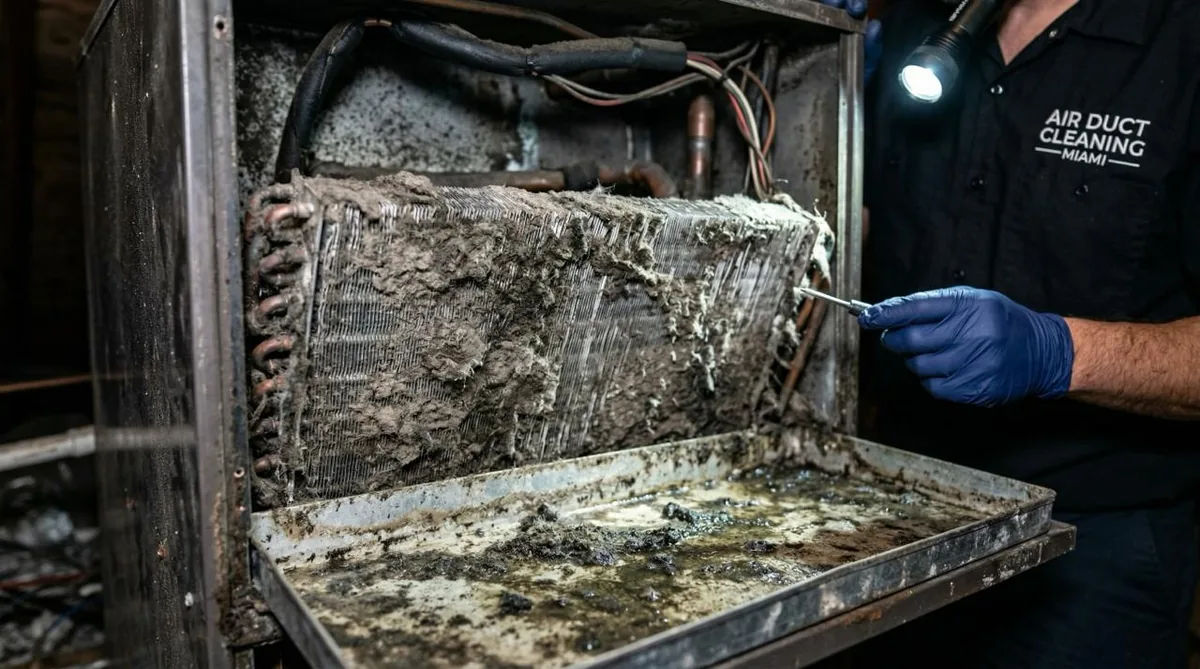
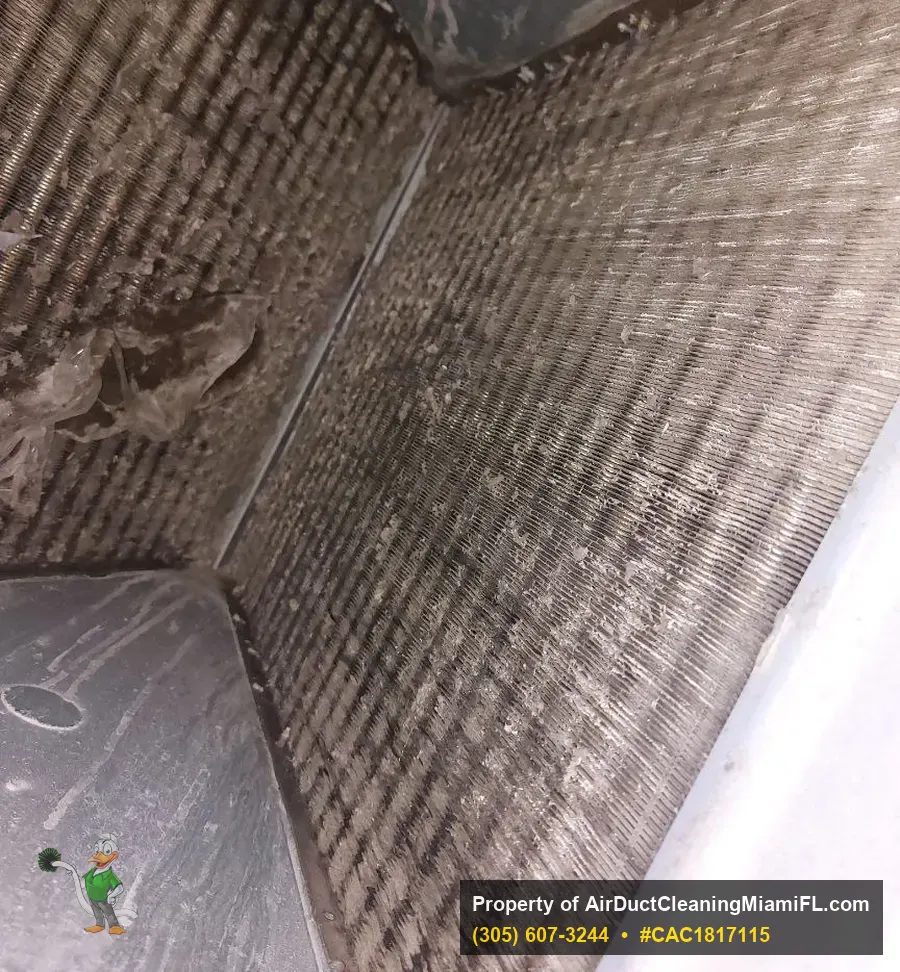
The cause. Nobody has looked at the coil, the refrigerant charge or the airflow in a year. The indoor coil has a film of dust and moisture on it, the charge drifted low over the summer, and the filter is choking the blower. Each one shaves capacity. Put them together and a system that should pull the house back 6 to 8 degrees in under an hour now runs three to four hours to recover the same 6 to 8 degrees.
The effect. Those extra hours of run time are the bill — every afternoon, all summer. And while the house sits warm, the humidity climbs. Hialeah air at 85% sits in your ducts and your air handler closet on a coil that is wet and warm at the same time. That is mold-friendly moisture, and it is why the "switch it off to save money" house so often has the wet-cat smell by August.
The prevention. Twice a year, a licensed tech cleans the coil, flushes the drain, checks the charge, measures the airflow and fits a fresh filter. That visit is what makes a setback cheap instead of expensive: the AC comes back fast, runs a short cycle and shuts off. It is the whole argument for the AC maintenance plan — not two visits for their own sake, but a system that recovers in minutes instead of hours every day you leave the house.
The solution. If your FPL bill jumped this summer and you have been switching the AC off to fight it, do not guess at which part is dragging. We come out, run the diagnostic free, and tell you exactly what the recovery time is costing you. From Hialeah Park to West Hialeah, ZIP 33012, across to Miami Lakes and the rest of Miami-Dade and Broward — call (305) 607-3244 or put both visits on the annual plan and stop paying for the recovery.
So What Should You Actually Do? Service Contract vs One-Time Tune-Up
Knowing the schedule is step one. Step two is choosing how you actually book it. In Miami, homeowners have two real options — and for most people, one wins on every metric: cost, priority, and peace of mind.
The Real AC Service Schedule for Miami (Month by Month)
If you live in Hialeah, Miami Lakes, Doral, or anywhere else in Miami-Dade and Broward, your AC runs 8 to 9 months a year. That is double what a system in Georgia or the Carolinas handles. Your tune-up calendar has to match that workload, not the generic "annual check" most national blogs recommend.
Here is the Hialeah homeowner's AC service schedule for South Florida heat:
| Month | What You Do | Why It Matters |
|---|---|---|
| January | Change filter. Check thermostat settings. | Dry season dust is still moving through the ducts. |
| February | Change filter. | Pollen starts — Florida's "allergy month." |
| March | Pre-summer professional tune-up. Book now. | Techs get crushed in May. Get ahead of the rush. |
| April | Change filter. Rinse condenser coil with a garden hose. | Last clean-slate month before the heat. |
| May | Change filter mid-month. Watch for warm air or weak airflow. | Runtime doubles. This is when weak systems die. |
| June | Hurricane season opens June 1. Check your surge protector. | A power surge can fry a compressor in one second. |
| July | Change filter. Flush the condensate drain line. | 85%+ humidity = standing water = mold risk. |
| August | Watch for ice on the copper line or water around the air handler. | Peak heat, peak breakdown month in Miami-Dade. |
| September | Change filter. | Still running 12+ hours a day. |
| October | Post-summer professional tune-up. Hurricane-season inspection. | Coils are dirty, drain line is gunked up. Clean it before dry-season setup. |
| November | Change filter. Test the heat mode for one cycle. | The two cold nights in January will test it — better to know now. |
| December | Change filter. Lock next March's appointment. | Early bookings get priority dispatch. |
Two professional visits a year. A fresh filter every 30 to 45 days. That is the Miami floor — not the ceiling.
What It Costs When You Skip AC Service in Miami
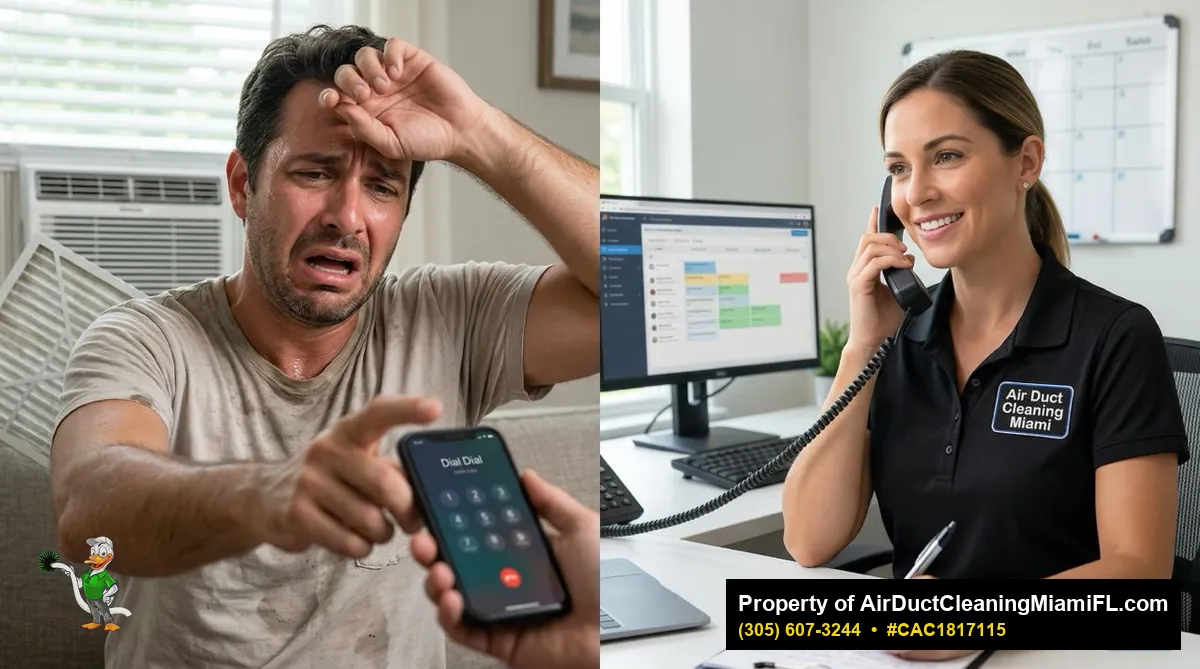
Two tune-ups a year feels optional — until something breaks. This is the part most Hialeah homeowners do not see until the bill lands. Here is the typical cost of not staying on the schedule above, based on what we actually see on service calls across Miami-Dade and Broward:
| What You Skip | What Breaks First | Typical Cost When It Hits |
|---|---|---|
| Pre-summer tune-up (March/April) | Weak capacitor fails on the first 90° day — no cold air | Emergency service call + capacitor replacement — often 4× the cost of a routine tune-up |
| Filter every 30–45 days | Frozen evaporator coil → compressor strain → premature compressor failure | Compressor replacement runs into the low thousands — one of the most expensive HVAC repairs |
| Condenser coil cleaning | Dirty coil → 15–30% higher electric bill every month | An extra $50–$95 on every FPL bill — roughly $600–$1,100 a year wasted on a coil you could have cleaned |
| Condensate drain line flush | Clogged drain → water overflows the air handler pan → ceiling damage | Drywall + ceiling repair + water mitigation — often far more than the service call would have cost |
| Routine AC maintenance (single-family home) | AC leaks water through the ceiling or walls → homeowner’s insurance denies the claim as “wear and tear, not sudden and accidental” | Roughly $75,000 out-of-pocket for drywall, flooring, cabinets, and mold remediation — insurance will not cover a leak from neglected maintenance |
| Routine AC maintenance (condo / high-rise) | Water leak floods your unit, the units below, shared hallways, and building common areas | Up to $500,000 in damages — you are liable for every affected unit, plus HOA deductibles and loss-of-use claims. Insurance denies on the same “wear and tear” clause. |
| Post-summer tune-up (October) | Hurricane-season debris + salt corrosion accelerates | Coil replacement — a preventable repair that routine cleaning would have avoided |
| Documented annual service | Manufacturer warranty voided on Carrier, Trane, Rheem, Goodman, Bryant | Out-of-warranty compressor or coil — thousands you would not have paid under warranty |
| Condo air handler sanitizing | Mold grows in the sealed closet → spreads through duct system | Full duct remediation — the $125,000 and $250,000 condo cases we handled in 2026 both started here |
| Annual Plan enrollment | No priority dispatch → 3–7 day wait in a heat wave + emergency fee | Emergency after-hours rate on top of parts — you pay a premium for skipping ahead of breakdowns |
Notice a pattern: every skipped step costs more than the tune-up would have. That is why we built the AC Service Contract — not to sell you more service, but to bundle the two visits, the filter reminders, the drain flush, and priority dispatch into one plan that costs less than one emergency call. Our full AC tune-up cost breakdown shows how the routine visit pricing compares to the emergency numbers above.
The insurance angle most Miami homeowners miss: if your AC leaks and damages your home, your insurance carrier will pull the maintenance records first. No documented service history? The claim gets denied as “wear and tear” — not “sudden and accidental” — and you pay the $75,000 out-of-pocket yourself. In a condo, where one leak can flood four or five units below you, that number climbs to half a million. Two tune-ups a year with a licensed HVAC contractor (license number #CAC1817115 on our invoices) is the paper trail your insurance company will ask for. Your own work, the building handyman, or the $99 guy from a Facebook ad does not count — the receipt needs a real Florida license number on it, or the carrier has every reason to deny.
Lock in Your Hialeah Pre-Summer Tune-Up — Before May
Two professional visits a year is the Miami floor. Book the March–April slot now — May fills up fast and emergency calls push the calendar.
Why Once a Year Is Not Enough in South Florida
The "service your AC annually" rule was written for houses in Ohio that run the compressor three months a year. Your Hialeah system runs it nine. You are putting roughly three times the hours on the same equipment, in salt air that corrodes aluminum fins, in humidity that grows mold inside your air handler closet, and in heat that pushes refrigerant pressure to the top of its range every single afternoon from May through September.
A single annual visit misses half of what breaks your system:
- Salt air eats the outdoor condenser coil faster in Miami-Dade and coastal Broward than anywhere else in the state. Twice-yearly cleaning keeps efficiency up.
- Humidity keeps your evaporator coil (the cold part inside the indoor unit) wet for 9 months. Wet + dirty = mold.
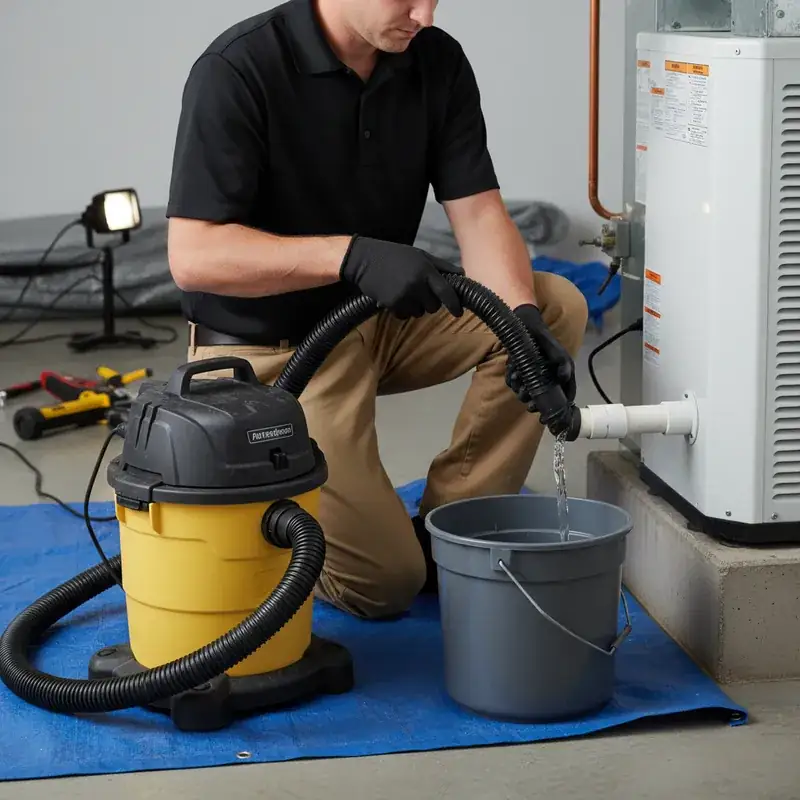
- Condensate drain lines clog with biofilm in Florida humidity — usually in July. A pre-summer flush is the cheapest insurance you will ever buy.
- Refrigerant pressure creeps up in peak heat. If your system is low by even 10%, your electric bill rises and your compressor dies early.
You can tell how hard your system is working by the bill. Every Hialeah homeowner we talk to eventually says, "my electric bill doubles every summer." Part of that is unavoidable heat. The other part — usually 15 to 30% of it — is a dirty coil, a weak capacitor, or a refrigerant charge that drifted low since last year. A professional AC maintenance in Miami visit catches all three.
Your Schedule Depends on Your Property Type
One blanket schedule does not work for every Miami home. The building matters. Here is how the twice-yearly floor shifts based on where you live.
Single-Family Homes (Most of Hialeah, Miami Lakes, Pembroke Pines)
The twice-yearly schedule above is your baseline. If your outdoor condenser sits in full sun on the south side of the house, add a mid-summer coil rinse in July. If you have pets or if anyone in the house has allergies, change the filter every 30 days instead of 45. If you run central air with an attic air handler, add an annual attic-side inspection — Florida attics hit 140°F and cook the ductwork insulation.
Brands we see most often in Hialeah homes: Rheem, Carrier, Goodman, Bryant, and Trane. Each manufacturer's warranty requires documented annual service — skip it and you may void a 10-year parts warranty on a compressor that costs thousands to replace.

Hialeah Condo Owners (and the Rest of Miami-Dade's High-Rises)
If you own a condo — especially a high-rise along West 49th Street or anywhere near the coast — your schedule is different. Your air handler usually sits in a sealed closet. Those closets do not breathe. Mold loves sealed closets in 85% humidity.
Twice a year is the floor. You also want an annual mold-prevention sanitizing service on top of the two tune-ups. We just serviced a condo in 2026 where the owner skipped maintenance for three years — mold grew through the entire duct system and the repair came in at $125,000 because the condo had hard ceilings that had to be torn down and rebuilt for duct access. Another case the same year hit $250,000 for the same reason. This is not a scare tactic. It is the math. A handful of tune-ups over those three years would have prevented it.
HOA rules matter too. Most Hialeah and Aventura HOAs require scheduled service windows and proof of licensing. We are licensed FL HVAC contractor #CAC1817115 and can submit COI to your building manager before the visit. Condo-specific air duct cleaning Miami pairs well with the annual sanitizing when the system has been neglected.
Hurricane Season Changes the Calendar

June 1 opens hurricane season. November 30 closes it. Every Miami homeowner should treat those six months as a distinct phase with its own service rhythm. None of the national HVAC blogs cover this — but it is the most Miami-specific piece of the calendar. For a deeper storm-readiness walkthrough, see how to prepare your AC for hurricane season.
Before June 1: pre-summer tune-up done by April, surge protector on the condenser, drain line flushed (storm rain raises the water table and backs drains up), fresh filter. After a named storm: look for a lifted condenser, bent fins or downed wires, listen for new noises on the first start, and if the power flickered for more than 30 seconds get it inspected before you run it hard. October or November: the post-hurricane tune-up — your second professional visit of the year.
We get calls every October that start with "it still runs but something sounds off." That is usually a hurricane-related micro-issue — a bent fin, a debris-clogged coil, a capacitor weakened by a power event. Catching it in October costs a service call. Catching it in February costs a compressor.
Is Your Hialeah AC Ready for Hurricane Season?
Enter your ZIP for a free pre-storm inspection. Surge protector, drain line flush, coil rinse, and a full post-storm readiness check.
The FPL Angle — Real Money on the Table
FPL publishes a residential cooling rebate list every spring. The rebate amounts shift year to year, but the pattern holds: they pay you to keep your AC efficient. Smart thermostats, heat pump upgrades, and documented annual maintenance all qualify in different years. Check FPL's current rebate list at the start of each summer — most Hialeah homeowners we talk to had no idea there was money sitting there.
Beyond rebates, the efficiency math is simple. A dirty coil pulls 15 to 30% more electricity to move the same heat out of your house. If your summer FPL bill is $320 and your coils have been dirty for two years, roughly $50 to $95 of that bill every month is the coil — not the heat. Two tune-ups a year at a fraction of that monthly overage pays for itself before July. For the full numbers, see our 2026 AC maintenance cost breakdown.
Early-Warning Signs You Need Service Sooner
Do not wait for the calendar if any of these show up. Book sooner.
- "My AC never catches up in May." Low refrigerant or a dirty coil. Book within a week.
- "My electric bill doubles every summer." Some of that is normal. The jump above last year's June-August average is not — that is the efficiency drop talking.
- "It smells like a wet cat when the AC kicks on." Mold in the air handler or the duct system. This one does not wait. Book today.
- "I think there's mold in my vents." Same answer. Do not run the AC until you know.
- "I feel worse indoors than outdoors." Indoor air quality issue — usually a biofilm on the coil or a dirty drain pan.
- Ice on the copper refrigerant line. Turn the AC off. Call for service same-day.
- Water pooling around the air handler. Drain line clog. Call today — this floods ceilings in condos fast.
- Weak airflow from one or two vents. Duct blockage or a failing blower motor.
Any of those signs and you are past due — the calendar does not matter anymore. Handle it now. For the cooling-capacity side of this list, our signs your AC is falling behind in Miami heat breakdown goes deeper.
One-Off Tune-Up vs. Annual Plan — The Math
Most Hialeah homeowners call us once, get a tune-up, and then forget until the next breakdown. That works for about a year. Then the filter goes six months instead of 30 days, the drain line clogs, and the May emergency call costs four times what the plan would have. The two cards near the top of this page show the line-by-line difference.
The plan is not marketing. It is the schedule this blog just walked you through — locked in, automated, and documented for your manufacturer warranty. When the twice-yearly AC service contract in Hialeah visits happen on time, the May "my AC never catches up" phone call never gets made in the first place.
The Ultimate Mold Fighter Machine condo package goes even further for high-rise owners — annual sanitizing, in-duct purification tech, and proper air handler installation bundled with the maintenance plan. That is the bundle that would have saved the $125K case we referenced above.
Enroll in the Annual AC Maintenance Plan — Hialeah and All of Miami-Dade
Two professional tune-ups a year, priority dispatch, parts discount, warranty documentation, and automatic reminders. The schedule locked in without you having to think about it.
Frequently Asked Questions
The Honest Answer
Twice a year is the floor. Condos should add the annual sanitizing visit. Commercial buildings need quarterly service. Hurricane season changes your calendar — pre-storm in April, post-storm in October. And the FPL math alone makes the schedule pay for itself before the season ends.
You already know the answer is not "when it breaks." The answer is a plan — booked, documented, and on a recurring cadence that matches how hard South Florida runs your equipment. Our Miami AC service contract is built exactly for that schedule. It covers both visits, both seasons, and both the pre-summer and post-hurricane angles you just read. It is the difference between the May phone call that starts with "my AC never catches up" and the summer where the thermostat just holds.
Call (305) 607-3244 or book a free estimate and we will put the Hialeah homeowner's schedule on the calendar for you — so you do not have to think about it again until we show up.